Café Wall Illusion
Perfectly parallel rows of tiles that seem to tilt into wedges.
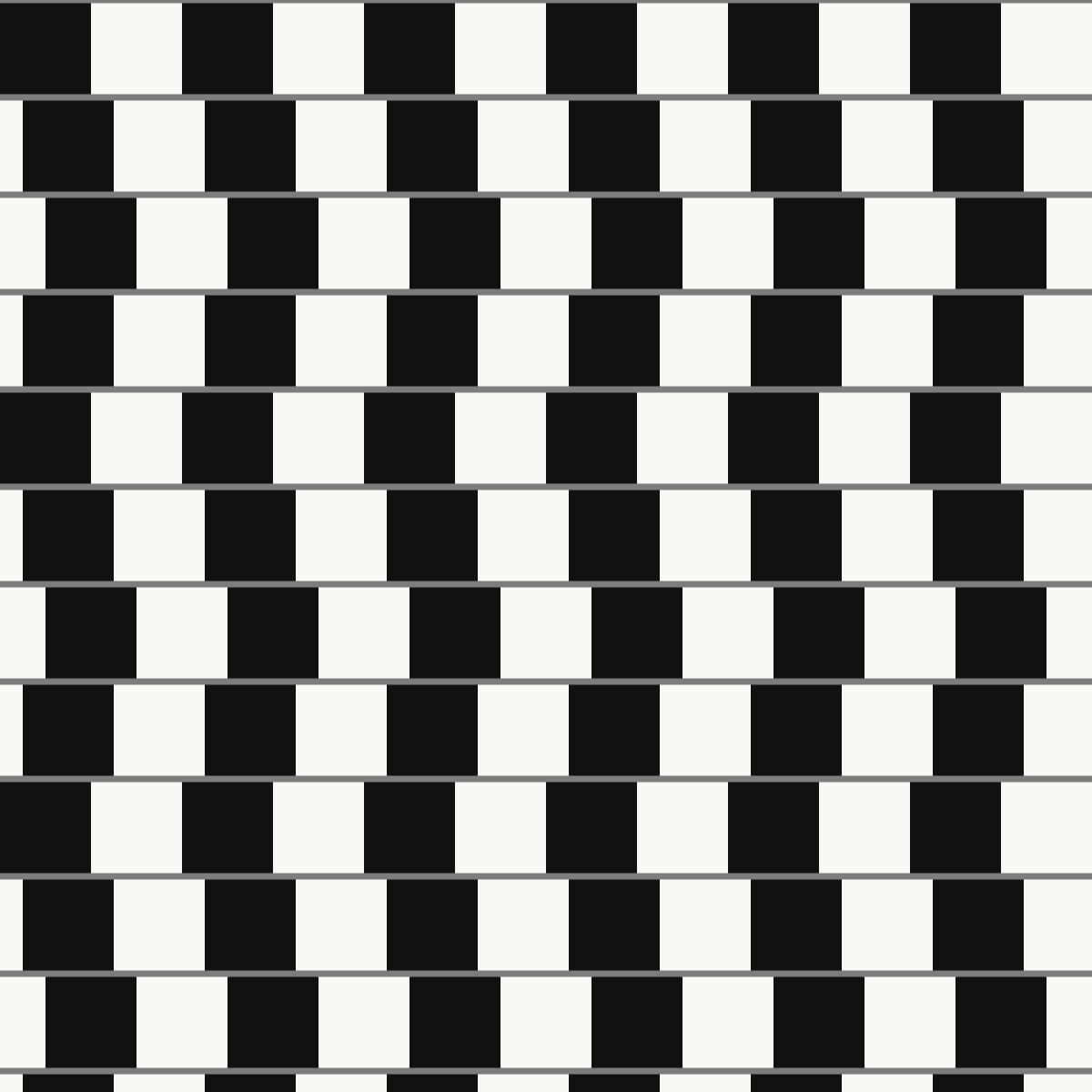
What do you see?
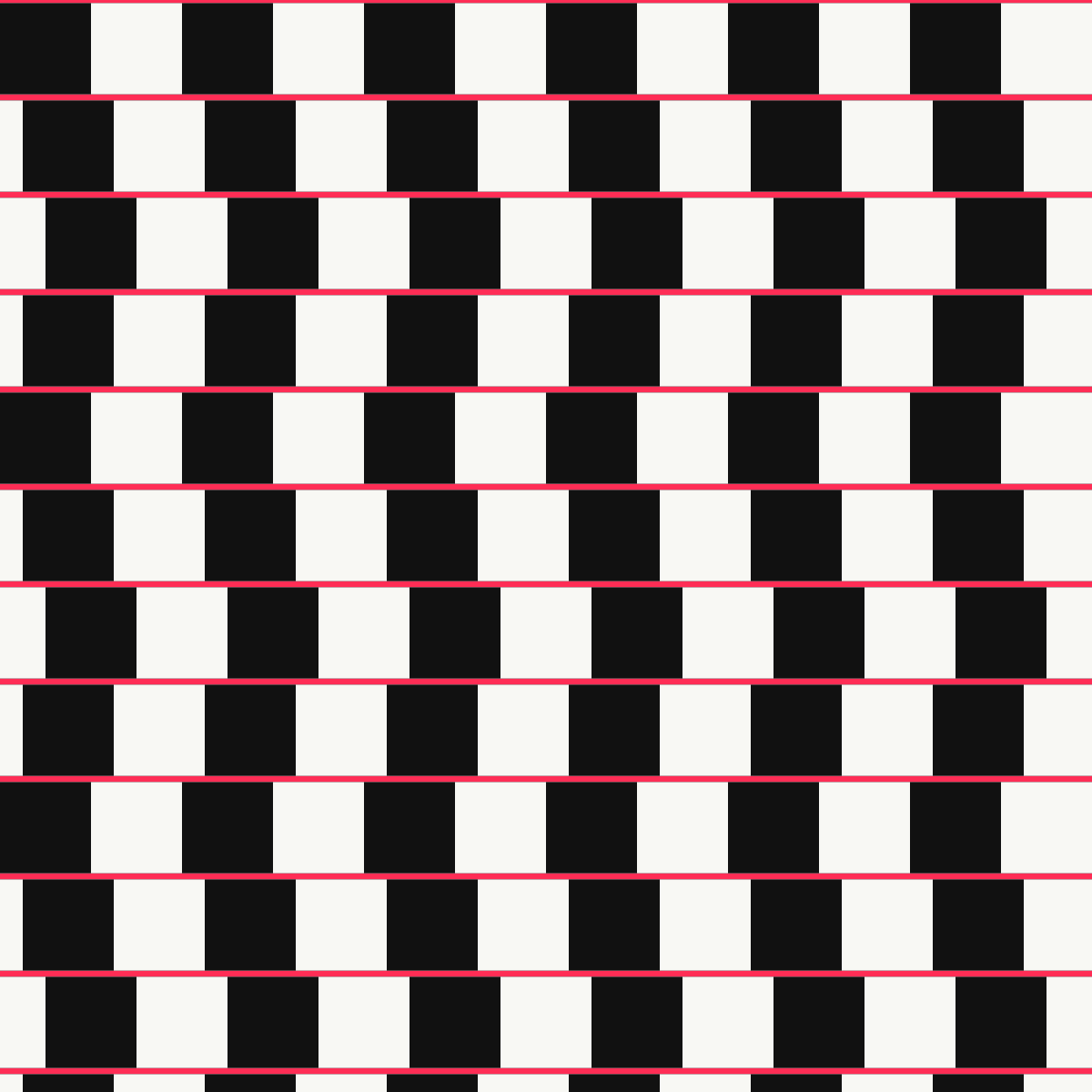
Rows of black and white tiles separated by thin grey lines of mortar. The rows look as if they are tapering, alternately wider at the left and wider at the right, so the whole wall seems to be built from long wedges. Press Reveal: every mortar line is perfectly horizontal and every row is exactly the same height.
Get Café Wall Illusion on a tee, mug or blanket
Printed to order with the OpticalIllusions.com wordmark.
How it works
Only three ingredients are needed: high-contrast tiles, rows offset by part of a tile, and a mortar line whose brightness sits between black and white. Remove any one of them and the tilt disappears. Make the mortar pure black or pure white and the lines look straight again. Line the tiles up in a plain checkerboard and the effect vanishes too.
The best-supported explanation works in two stages. In the first, the visual system processes the image with neurons that have centre-surround receptive fields, which respond to local differences in brightness rather than absolute light levels. Around the grey mortar, these cells produce distorted responses: where a black tile sits above the mortar and a white tile below, the mortar is pushed toward looking light on one side and dark on the other. Along each line, this creates a chain of small tilted edge fragments, a bit like short diagonal dashes, sloping in a consistent direction between each pair of offset tiles.
In the second stage, orientation-selective neurons, which detect the tilt of lines, pick up these tiny slanted fragments. The brain links them along the length of the mortar line, and the long line inherits their slope. Because the tile offset alternates direction from row to row, the inferred slope alternates too, producing the characteristic wedges.
Computer models that filter the image with centre-surround and oriented filters reproduce the illusion convincingly, which is good evidence that the distortion begins early in vision rather than in higher reasoning. The illusion also depends on scale: when you move very far away, so that the mortar becomes too thin to register, or very close, so that each tile is large, the effect weakens.
This illusion belongs to a family sometimes called twisted-cord illusions, which also includes the Fraser spiral. In each case, small local tilts are integrated into a global shape that the picture does not contain.
History
The illusion was named by Richard Gregory and Priscilla Heard, who described it in 1979 after a member of Gregory's lab noticed the effect in the tiled wall of a café on St Michael's Hill in Bristol, England. A related checkerboard version had been published in 1897 by Hugo Münsterberg, and similar patterns appear in children's kindergarten designs from the nineteenth century. This wall was drawn for OpticalIllusions.com.
Try it
- Press Reveal to overlay straight red lines on the mortar.
- Hold a ruler or the edge of a card against the screen along one row.
- Squint or step back several metres: the wedges change strength with distance.
- Look for café wall effects in real tiled walls and bathroom floors.
Written by K.R. for OpticalIllusions.com · Updated . Illusion artwork © The Wizard Of Sales, LLC. Feel free to share a link; see our terms for reuse.
Related illusions
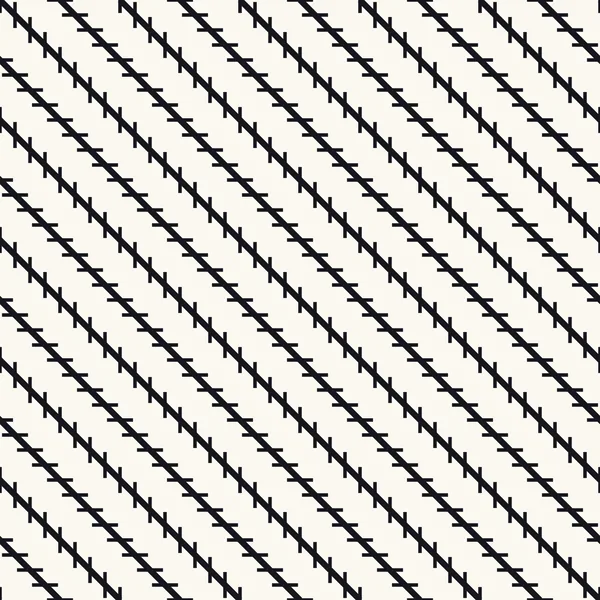 Geometric illusionsZöllner IllusionShort hatches make long parallel lines seem to tilt toward each other.
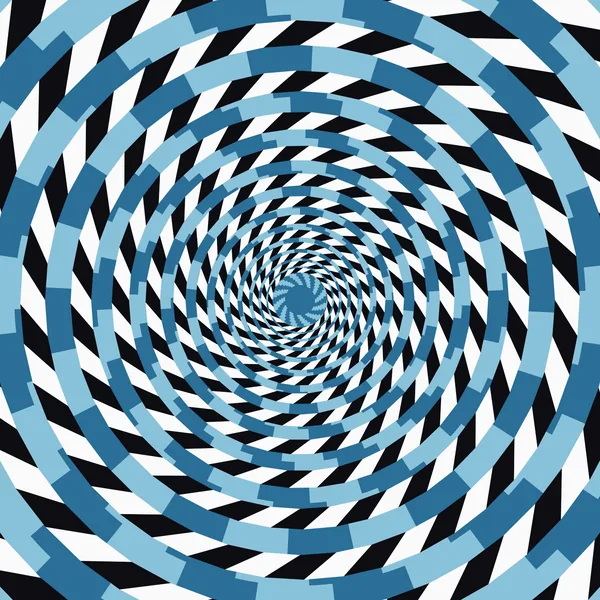 Geometric illusionsFraser SpiralConcentric circles of twisted cord that look like one big spiral.
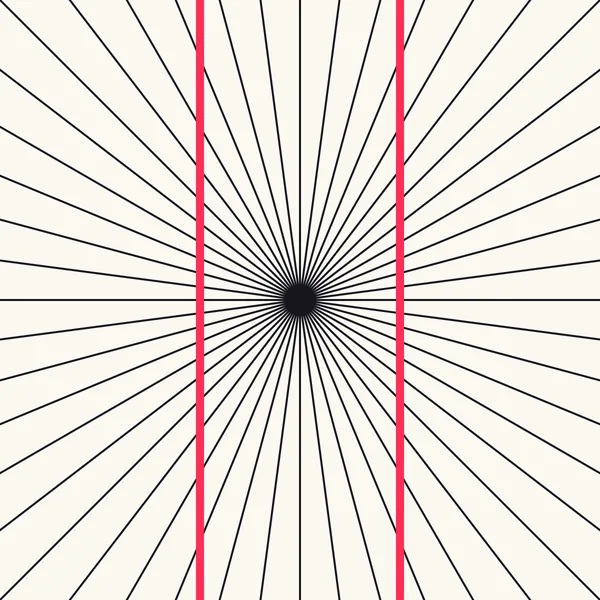 Geometric illusionsHering IllusionTwo straight red lines bulge apart over a burst of rays.
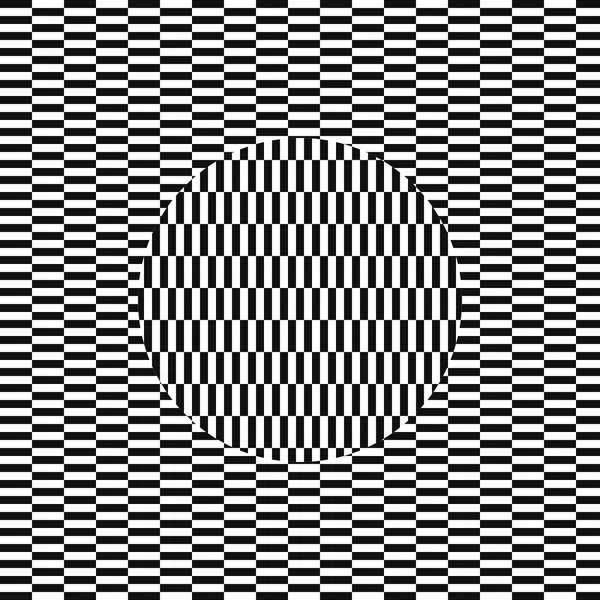 Motion illusionsOuchi IllusionA checkered disc that seems to float and slide over its background.