
Chubb Illusion
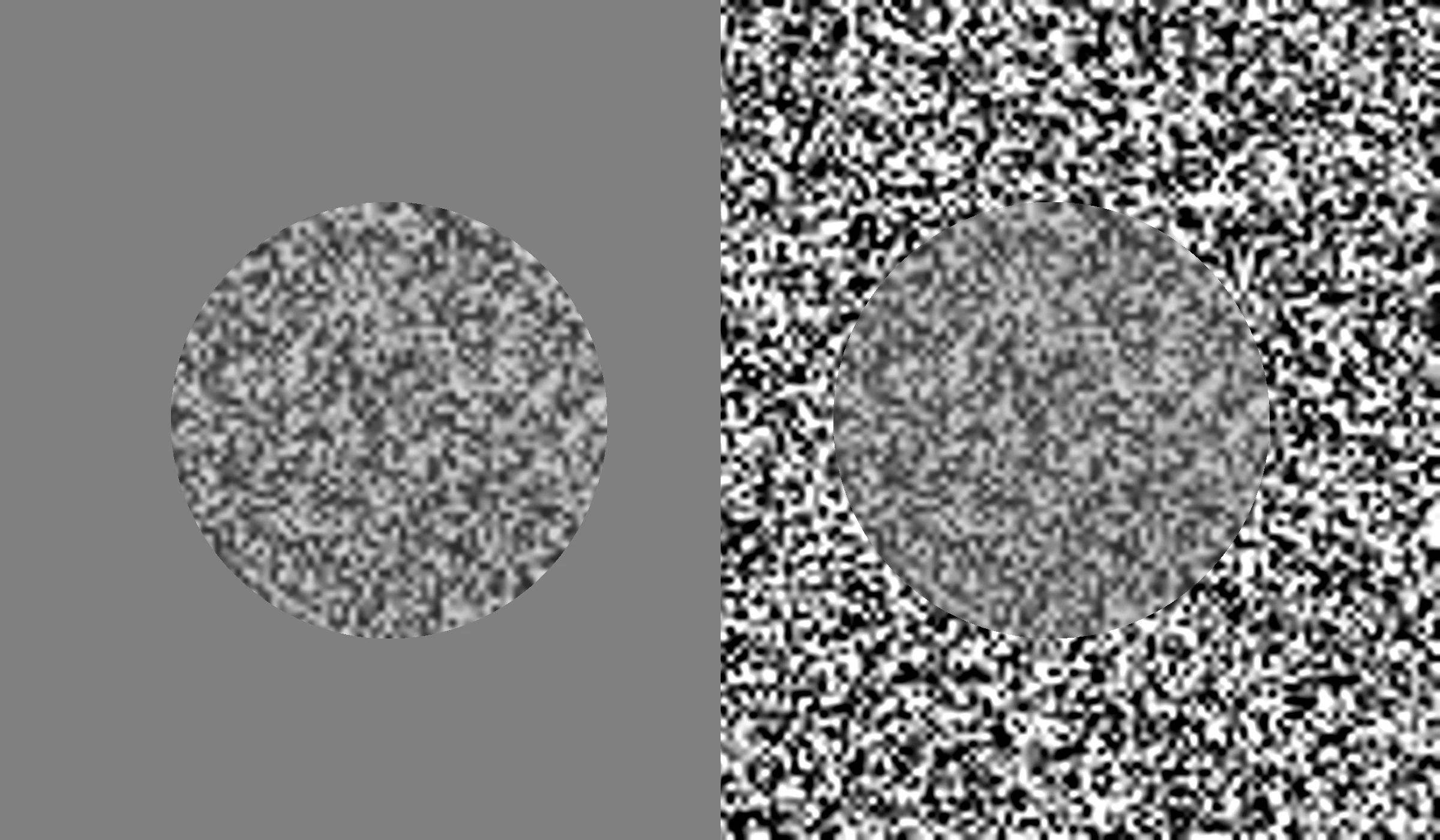
Two identical textured discs: the one in the busy surround looks washed out.
What do you see?
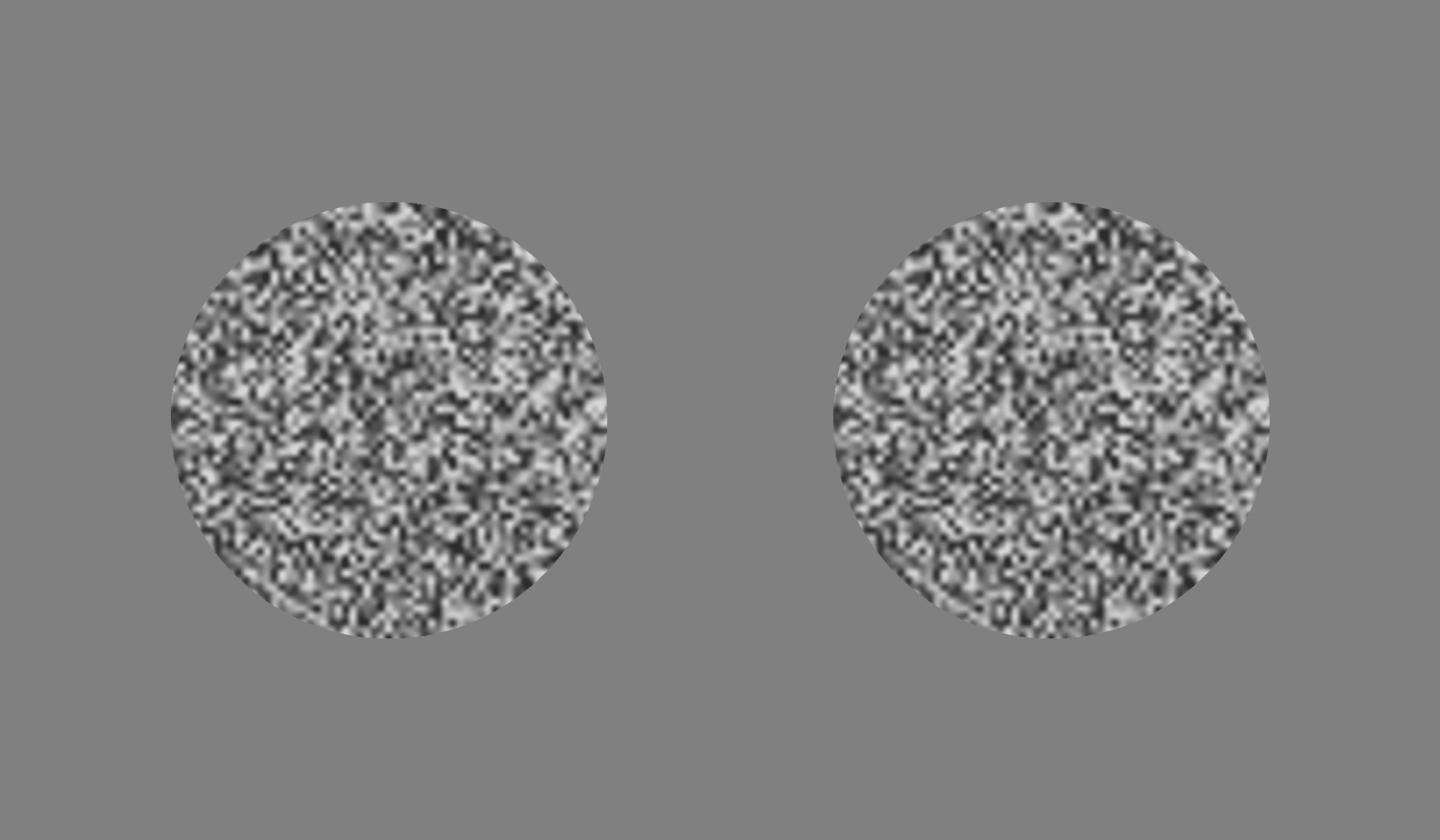
Two round textured patches. The left one sits on plain gray and looks crisp and contrasty. The right one sits on a busy, high-contrast texture and looks duller, as if it had been faded or seen through mist. The two discs contain exactly the same pattern with exactly the same contrast. Press the reveal button to replace the busy surround with plain gray and compare.
How it works
The Chubb illusion shows that the visual system judges contrast relative to its surroundings, in the same way that it judges brightness and size relative to context. Contrast is the difference between the light and dark parts of a texture. Your visual system adapts to the typical contrast in a region and reports the contrast of each patch compared with that typical level.
When the disc is surrounded by flat gray, its contrast is judged against a background with no contrast at all, so it looks strong. When the same disc is surrounded by a texture with much higher contrast, it is judged against that busy surround and looks weak. This is sometimes called contrast-contrast, a term used in the original 1989 paper by Charles Chubb, George Sperling and Joshua Solomon.
The effect is thought to come from contrast gain control, a kind of automatic volume knob in the visual system. Neurons that respond to texture contrast are suppressed by activity in neighboring neurons. A high-contrast surround produces a lot of activity, which turns down the response to the center, so the center's contrast is reported as lower. Similar mechanisms help the visual system cope with scenes that range from very low contrast, like fog, to very high contrast, like sunlight through leaves.
Interestingly, the effect is stronger when the center and surround have similar textures, with similar sizes of light and dark blobs and similar orientations. This suggests that the suppression comes mainly from neurons tuned to similar features, which is consistent with how contrast gain control is organized in the visual cortex.
The illusion has been used to study conditions in which contrast processing may differ. For example, some studies have reported that people with schizophrenia show a weaker Chubb illusion, and therefore judge the center's contrast more accurately, although these findings are still being explored.
History
The illusion was described in 1989 by Charles Chubb, George Sperling and Joshua A. Solomon in the Proceedings of the National Academy of Sciences, in a paper on lateral interactions in perceived contrast. The textured image on this page was drawn pixel by pixel for Opticalillusions.com from a fixed random pattern, so both discs are guaranteed identical.
Try it
- Press reveal and back again while keeping your eyes on the right disc.
- Cover the busy surround with your hands and compare the discs.
- Move closer and further away: does the effect change with the size of the texture?
- Look at a shadowed patch of grass next to bright gravel and notice which looks more vivid.
Frequently asked questions
Are the two textured discs really the same?
Yes. They contain exactly the same pattern with exactly the same contrast. Press the reveal button to replace the busy surround and compare.
Why does the disc on the busy background look duller?
Your visual system judges contrast against what surrounds it. Next to a high-contrast texture, the same disc seems weaker, as if seen through mist.
Who discovered the Chubb illusion?
Charles Chubb, George Sperling and Joshua A. Solomon described it in 1989 in the Proceedings of the National Academy of Sciences.
Sources & credits
Described by Charles Chubb, George Sperling and Joshua A. Solomon (1989).
- Chubb, C., Sperling, G. & Solomon, J. A. (1989). Texture interactions determine perceived contrast. Proceedings of the National Academy of Sciences, 86.
- Dakin, S., Carlin, P. & Hemsley, D. (2005). Weak suppression of visual context in chronic schizophrenia. Current Biology, 15.
- Chubb illusion — overview Read →
Further reading: The Illusions Index (University of Glasgow) and Michael Bach’s Optical Illusions & Visual Phenomena.
Written by K.R. for Opticalillusions.com · Updated . Illusion artwork © The Wizard Of Sales, LLC. Feel free to share a link; see our terms for reuse.
Related illusions
 InteractiveBrightness illusionsSimultaneous ContrastA uniform gray bar looks lighter on the left and darker on the right.
 InteractiveBrightness illusionsMach BandsA smooth ramp from dark to light that grows a dark stripe and a bright stripe.
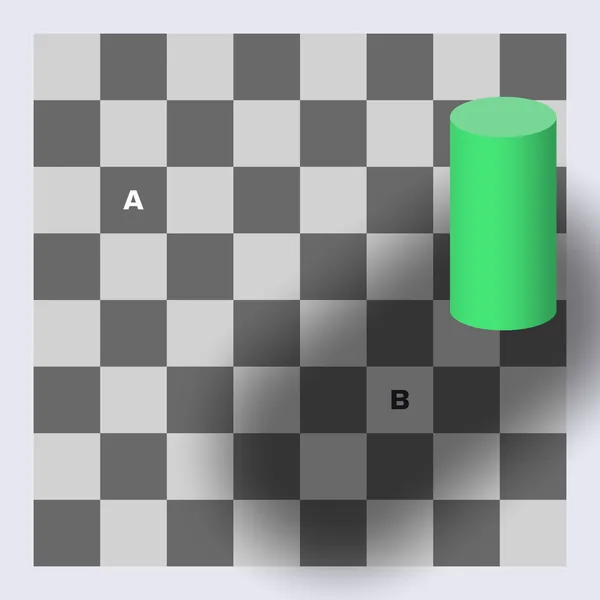 InteractiveBrightness illusionsCheckerboard Shadow IllusionA dark square in light and a light square in shadow are the same gray.
 InteractiveBrightness illusionsCornsweet IllusionLeft and right halves are the same gray, but the left looks lighter.