
Mach Bands
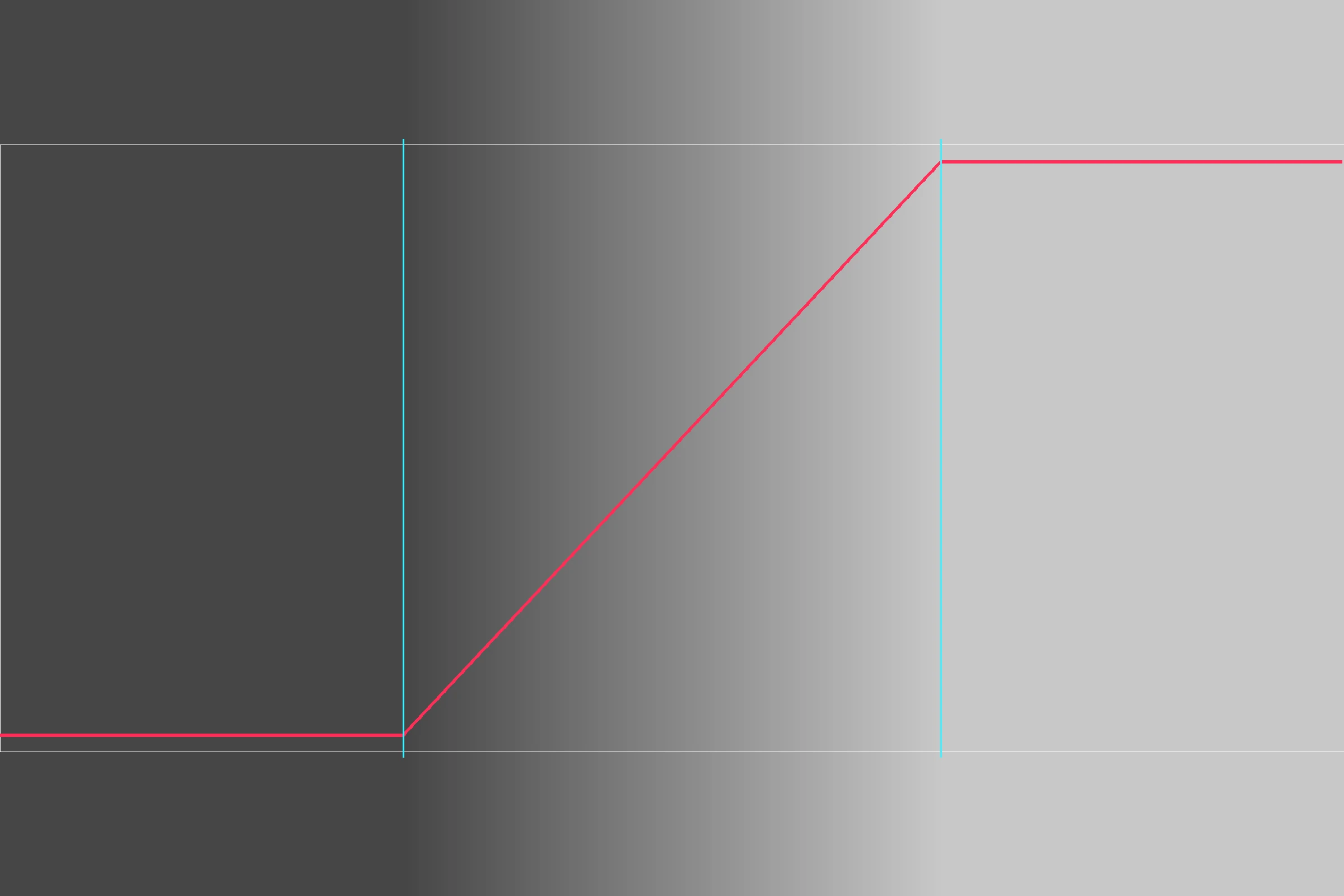
A smooth ramp from dark to light that grows a dark stripe and a bright stripe.

What do you see?
A dark gray area on the left, a smooth ramp in the middle and a light gray area on the right. Look at the point where the dark area meets the ramp: there is a narrow strip that looks even darker than the dark area. Where the ramp meets the light area, there is a strip that looks even brighter than the light area. Neither strip is in the image. Press the reveal button to see a graph of the real brightness across the picture: flat, a straight ramp, then flat again.
How it works
Mach bands are a classic sign that your visual system emphasizes changes in brightness rather than simply recording brightness. Wherever the rate of change suddenly alters, your eye adds a band that exaggerates the corner.
The standard explanation is lateral inhibition. Neurons in the retina are connected so that each cell is excited by light falling in its center and inhibited by light falling in the surrounding area. A cell sitting on the dark plateau just before the ramp has a center in the dark and part of its surround on the lighter ramp. It gets more inhibition than cells deeper in the dark area, so it signals something darker still. A cell just past the top of the ramp has part of its surround on the slightly darker ramp. It gets less inhibition than cells deeper in the light area, so it signals something brighter. The result is a dark band and a bright band.
This kind of processing is useful. It makes edges and changes stand out, which helps you spot the outlines of objects. Image-editing software uses a similar idea, called sharpening or unsharp masking, to make photos look crisper.
Lateral inhibition is not the whole story, however. Mach bands do not appear at every edge that the simple model predicts. For example, they are weak or absent at a sharp step from dark to light, which is why researchers think later stages of vision, which interpret surfaces and edges, also shape the effect.
Mach bands appear in everyday images. Look at the soft edge of a shadow on a bright day and you may see a slightly darker line along the inside of the shadow and a lighter line just outside it. Radiologists are trained to recognize Mach bands in X-ray images so they do not mistake them for real features in the body.
History
The Austrian physicist and philosopher Ernst Mach described the bands in 1865, after noticing them on rotating discs with carefully shaped black and white patterns. Mach was also known for his work on shock waves, and the Mach number used for speeds is named after him. The image on this page was drawn pixel by pixel for Opticalillusions.com with a perfectly linear ramp.
Try it
- Press reveal and compare the graph with what you see.
- Cover the ramp with paper so that only the plateaus show: the bands disappear.
- Look at the edge of a soft shadow outdoors and look for a dark line along it.
- Squint at the image and notice whether the bands get stronger or weaker.
Frequently asked questions
Are the dark and bright strips really there?
No. Neither strip is in the image. Press the reveal button to see a graph of the real brightness: flat, a straight ramp, then flat again.
Why do I see Mach bands?
Cells in your retina are excited by light in their center and held back by light around it. Near the ends of the ramp, this makes one strip look darker and another look brighter.
Who discovered Mach bands?
Austrian physicist and philosopher Ernst Mach described them in 1865. The Mach number used for speeds is named after him.
Why is this kind of seeing useful?
It makes edges and changes stand out, which helps you spot the outlines of objects.
Sources & credits
Described by Austrian physicist Ernst Mach (1865).
- Mach, E. (1865). Über die Wirkung der räumlichen Vertheilung des Lichtreizes auf die Netzhaut. Sitzungsberichte der Kaiserlichen Akademie der Wissenschaften, 52.
- Ratliff, F. (1965). Mach Bands: Quantitative Studies on Neural Networks in the Retina. Holden-Day.
- Mach bands — overview Read →
Further reading: The Illusions Index (University of Glasgow) and Michael Bach’s Optical Illusions & Visual Phenomena.
Written by K.R. for Opticalillusions.com · Updated . Illusion artwork © The Wizard Of Sales, LLC. Feel free to share a link; see our terms for reuse.
Related illusions
 InteractiveBrightness illusionsCornsweet IllusionLeft and right halves are the same gray, but the left looks lighter.
 InteractiveBrightness illusionsSimultaneous ContrastA uniform gray bar looks lighter on the left and darker on the right.
 Brightness illusionsHermann GridGray smudges flicker at the crossings of a black-and-white grid.
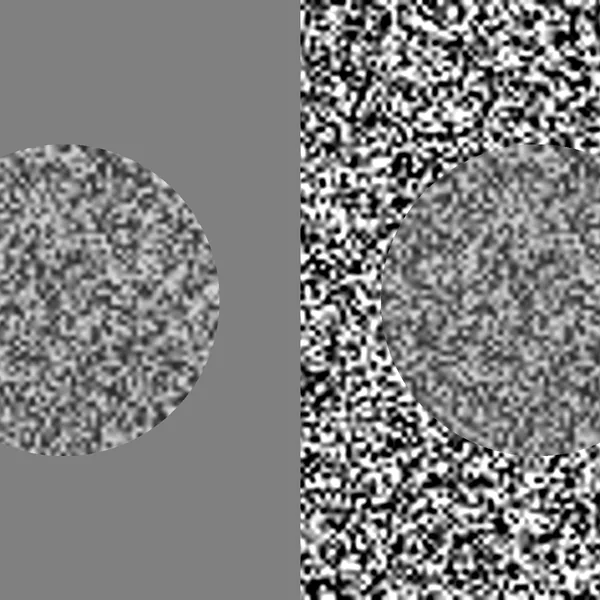 InteractiveBrightness illusionsChubb IllusionTwo identical textured discs: the one in the busy surround looks washed out.