
Devil's Fork
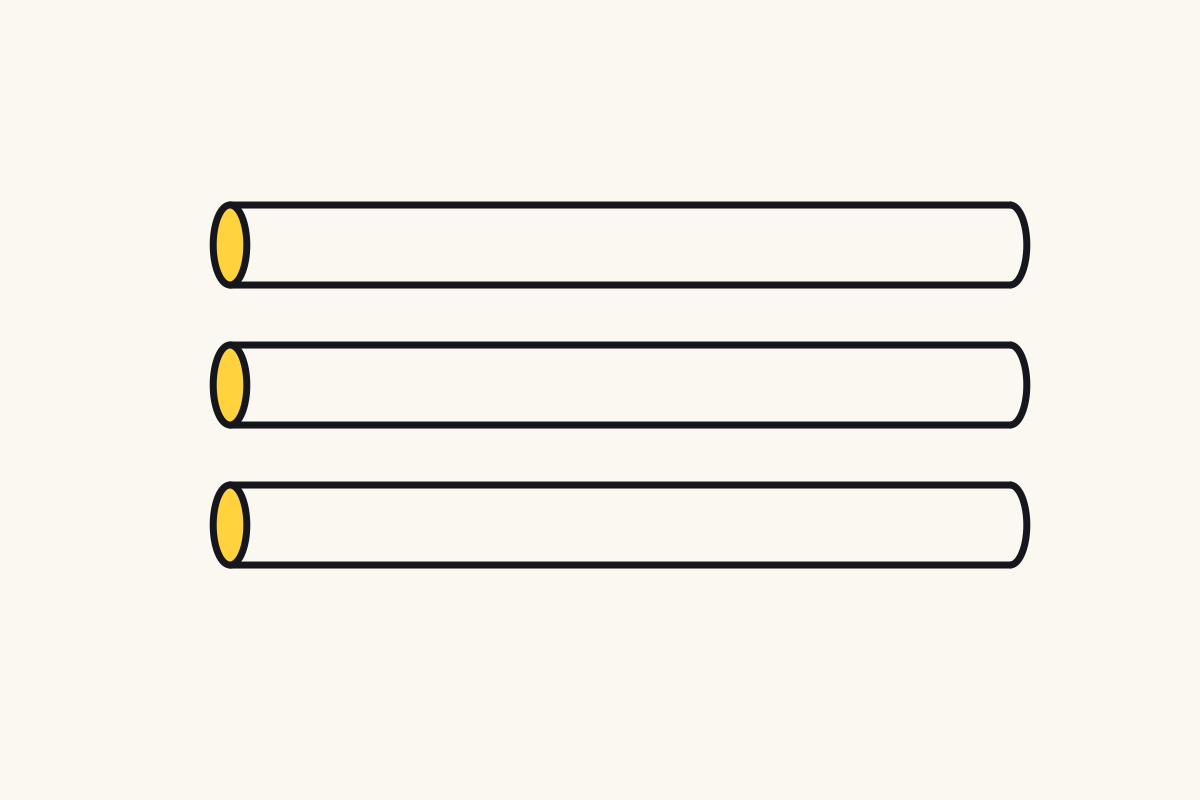
Three round prongs at one end turn into two flat prongs at the other.


Get this illusion on a hoodie, mug or poster
Devil's Fork, printed to order with the Opticalillusions.com wordmark.
What do you see?
On the left, three round prongs with yellow ends, like the tips of three pipes. Follow them to the right and they turn into two flat prongs with square ends. Look at the left end and the object makes sense. Look at the right end and it also makes sense. Try to take in the whole thing at once and it falls apart, because the space between two of the round prongs has become the solid surface of a flat one.
How it works
The devil's fork, also called the blivet or impossible trident, is an impossible figure that plays with the difference between lines and surfaces. A line in a drawing is just a mark, but your visual system decides what each line means: an edge where a surface ends, a crease where two surfaces meet, or the outline of a round tube. The same line can mean different things in different places.
At the left end, the yellow ellipses tell your brain that it is looking at the ends of cylinders. Each pair of lines is read as the two sides of a round tube, and the strips between tubes are read as empty background. At the right end, the square closing lines tell your brain that it is looking at two flat bars, and the strip in the middle is read as a gap. The trouble is that some lines change meaning along their length. A strip that is empty space on the left becomes solid bar on the right, and the two inner lines of the outer tubes simply stop halfway.
Your visual system interprets small regions first and does not insist that every interpretation is consistent with every other. The middle of the drawing is where the two readings meet, and it is deliberately long enough that your eye cannot hold both ends sharply at once. When you look at the left, the left reading wins; when you look at the right, the right reading wins.
The figure is a good example of why vision scientists talk about perception as a construction. The page contains only a few straight lines and three ellipses. The tubes, the bars, the solid surfaces and the gaps are all things your brain adds.
Short versions of the figure are much less convincing. If the prongs are short, you can see both ends at once and the contradiction becomes obvious. This is why artists stretch the middle section, and why the reveal button, which shows three ordinary tubes, feels so different.
History
The figure spread in the United States in 1964 and 1965. Psychologist D. H. Schuster described it in the American Journal of Psychology in 1964 as a new ambiguous figure, and it appeared on the cover of Mad magazine in March 1965, which gave it wide fame. The drawing on this page is an original version made for Opticalillusions.com.
Try it
- Cover the right half: you see three tubes. Cover the left half: you see two bars.
- Count the lines along the middle and decide what each one is.
- Try drawing one with short prongs and notice how much weaker it is.
- Show it to a friend and ask them to copy it from memory.
Frequently asked questions
Does the devil's fork have three prongs or two?
Both, depending on where you look. The left end shows three round prongs and the right end shows two flat ones, which is why the whole object cannot exist.
Why does the devil's fork confuse my eyes?
Your brain decides what each line means, and some lines change meaning along their length. A strip that is empty space on the left becomes a solid bar on the right.
What else is the devil's fork called?
It is also called the blivet or the impossible trident.
Where did the devil's fork come from?
It spread in the United States in 1964 and 1965. Psychologist D. H. Schuster described it in 1964, and it appeared on the cover of Mad magazine in March 1965.
Sources & credits
Described by D. H. Schuster (1964); popularized by the March 1965 cover of Mad magazine. Our drawing is original.
- Schuster, D. H. (1964). A new ambiguous figure: a three-stick clevis. American Journal of Psychology, 77.
- Impossible trident — overview Read →
Further reading: The Illusions Index (University of Glasgow) and Michael Bach’s Optical Illusions & Visual Phenomena.
Written by K.R. for Opticalillusions.com · Updated . Illusion artwork © The Wizard Of Sales, LLC. Feel free to share a link; see our terms for reuse.
Related illusions
 Impossible & ambiguous figuresImpossible TriangleThree bars meet at right angles to form a triangle that cannot exist.
 InteractiveImpossible & ambiguous figuresImpossible CubeA cube frame where one beam passes both in front of and behind another.
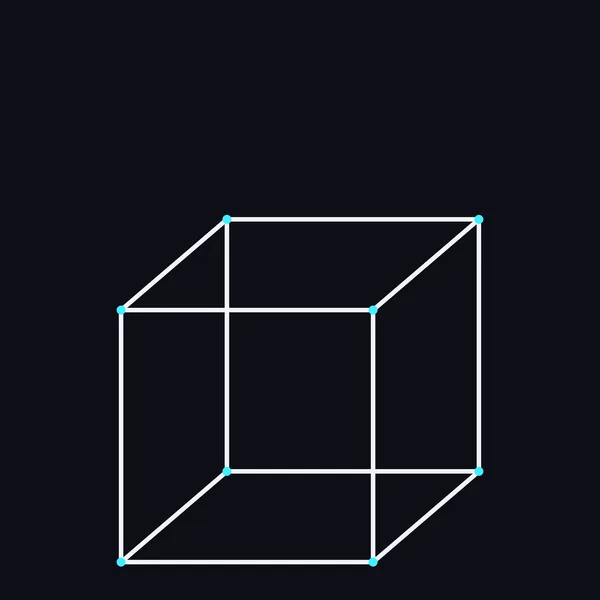 Impossible & ambiguous figuresNecker CubeA wireframe cube that flips between two orientations.
 Geometric illusionsKanizsa TriangleA bright white triangle appears from nothing but three cut-out discs.