
Impossible Cube
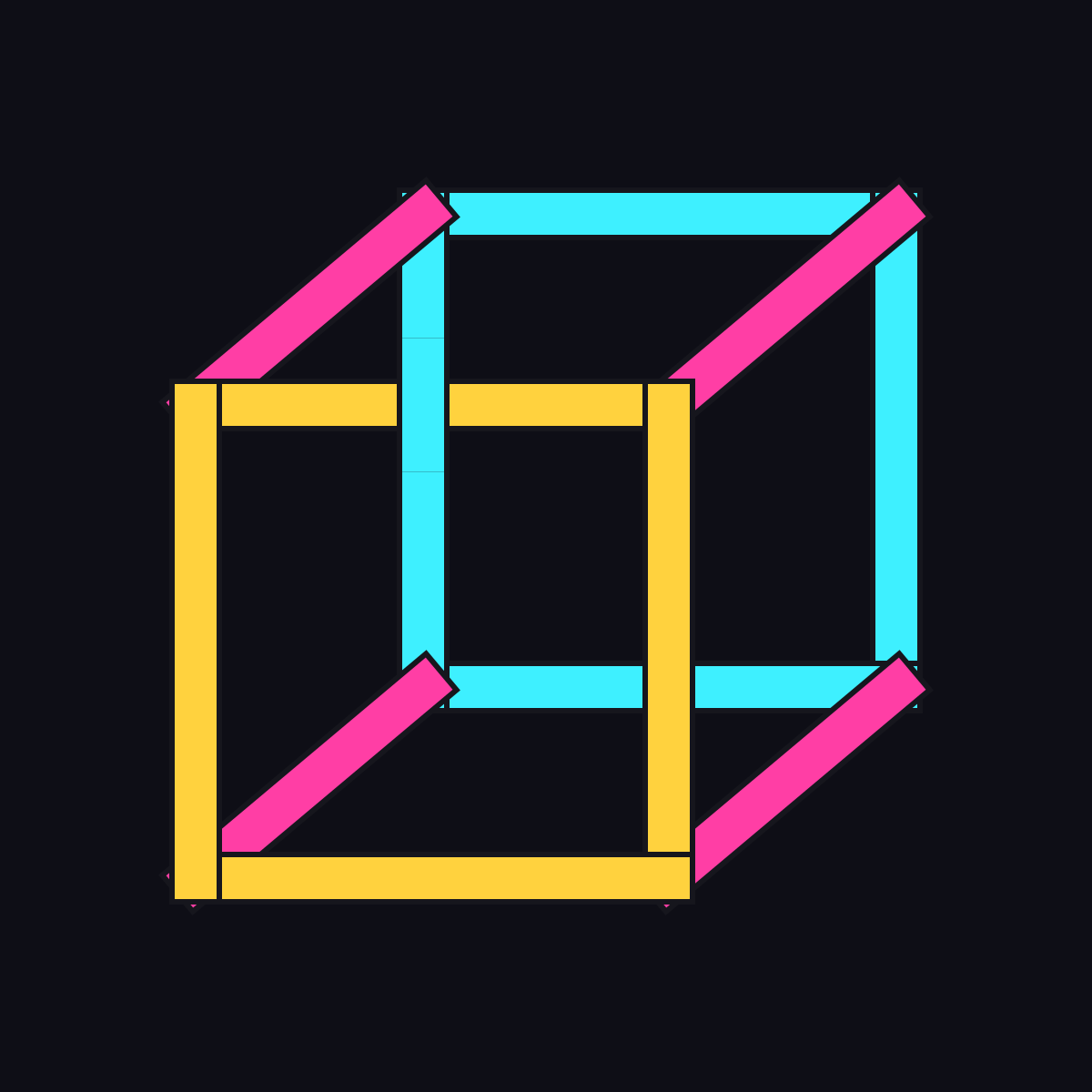
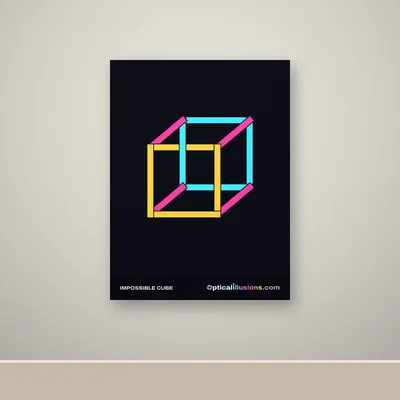
A cube frame where one beam passes both in front of and behind another.
Get this illusion on a hoodie, mug or poster
Impossible Cube, printed to order with the Opticalillusions.com wordmark.
What do you see?
A cube made of square beams in three colors: yellow at the front, pink running back, blue at the back. At first glance it looks like a solid frame. Now follow the blue upright on the left, near the top. It crosses in front of the yellow top bar of the front face, even though it belongs to the back of the cube. Further down, the other crossings behave normally. The frame could not be built as drawn.
How it works
The impossible cube is built on top of a Necker cube, the wireframe cube that flips between two orientations. A Necker cube is ambiguous: without depth clues, either square can be the front. When the edges are drawn as solid beams, they start to overlap each other, and overlap is one of the strongest depth clues there is. A beam that covers another is read as nearer.
In a normal frame, all the overlaps agree. Every place where a back beam meets a front beam, the front beam covers it. In the impossible cube, one crossing has been reversed. Locally, that crossing tells your brain that the back beam is nearer. Everywhere else, the overlaps tell it the opposite. Your visual system interprets each crossing and each corner separately and quickly, so each part looks fine on its own. The contradiction exists only in the whole object.
This is the same principle behind the Penrose triangle and the devil's fork. Your brain builds a three-dimensional interpretation from local clues and does not automatically check that the interpretation is globally consistent. Only when you deliberately trace a beam from one end to the other does the problem become obvious.
Photographs of impossible cubes can be made with real objects. One way is to build a frame with a gap in one beam and photograph it from the single angle where another beam fills the gap. Another is to edit the photo. In both cases the trick depends on a single fixed viewpoint, which is exactly what a flat drawing gives you.
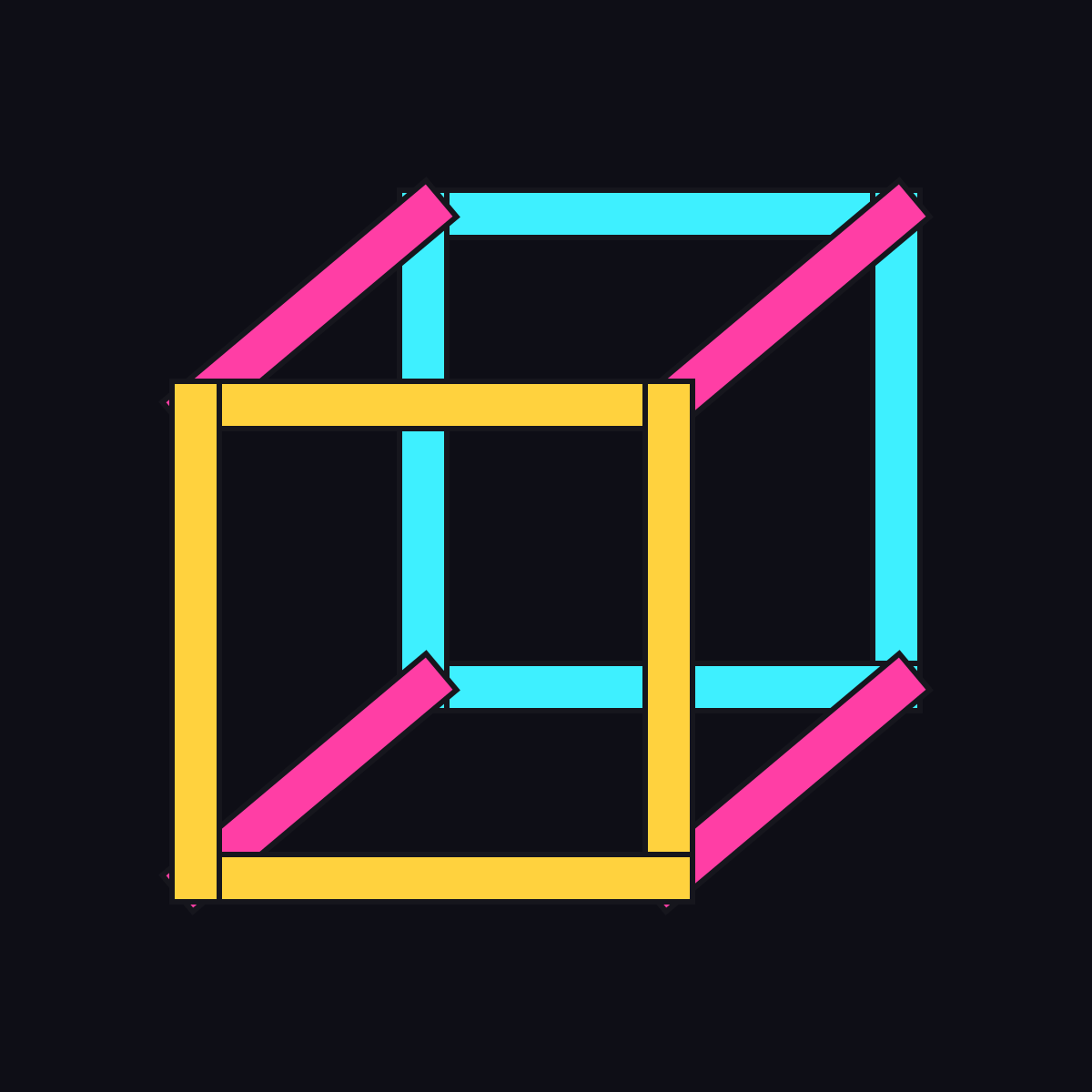
The reveal button shows the possible version, in which the blue beam goes behind the yellow bar as it should. Switching back and forth makes the tiny change, and its big effect, easy to see.
History
The impossible cube was made famous by the Dutch artist M. C. Escher, whose 1958 lithograph Belvedere shows a seated figure holding one, next to a building whose pillars contain the same contradiction. Impossible figures were studied seriously after Lionel and Roger Penrose published their impossible triangle and staircase in 1958. The cube on this page is an original drawing made for Opticalillusions.com; Escher's artwork is his own and is not reproduced here.
Try it
- Trace the blue left upright with your finger from bottom to top.
- Press the reveal button and compare the two crossings.
- Cover the top half of the picture: what is left is a perfectly possible cube.
- Try drawing a Necker cube with thick edges, then swap one overlap.
Frequently asked questions
Could the impossible cube be built?
No. One crossing has been reversed so a back beam passes in front of a front beam. The frame could not be built as drawn.
Why does the impossible cube look normal at first?
Your brain reads each crossing and corner separately, so each part looks fine. The problem only shows up when you trace a beam from end to end.
Who made the impossible cube famous?
Dutch artist M. C. Escher made it famous in his 1958 lithograph Belvedere, which shows a seated figure holding one.
How is it related to the Necker cube?
It is built on top of a Necker cube, the wireframe cube that flips between two orientations. Drawing the edges as solid beams adds overlaps, and one overlap is reversed.
Sources & credits
Made famous by M. C. Escher's lithograph Belvedere (1958), which is not reproduced here; our cube is an original drawing.
- Penrose, L. S. & Penrose, R. (1958). Impossible objects: a special type of visual illusion. British Journal of Psychology, 49.
- Impossible cube — overview Read →
Further reading: The Illusions Index (University of Glasgow) and Michael Bach’s Optical Illusions & Visual Phenomena.
Written by K.R. for Opticalillusions.com · Updated . Illusion artwork © The Wizard Of Sales, LLC. Feel free to share a link; see our terms for reuse.
Related illusions
 Impossible & ambiguous figuresImpossible TriangleThree bars meet at right angles to form a triangle that cannot exist.
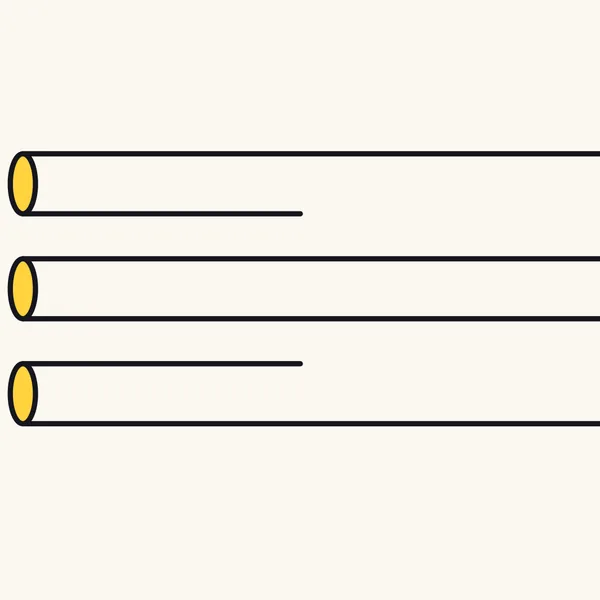 InteractiveImpossible & ambiguous figuresDevil's ForkThree round prongs at one end turn into two flat prongs at the other.
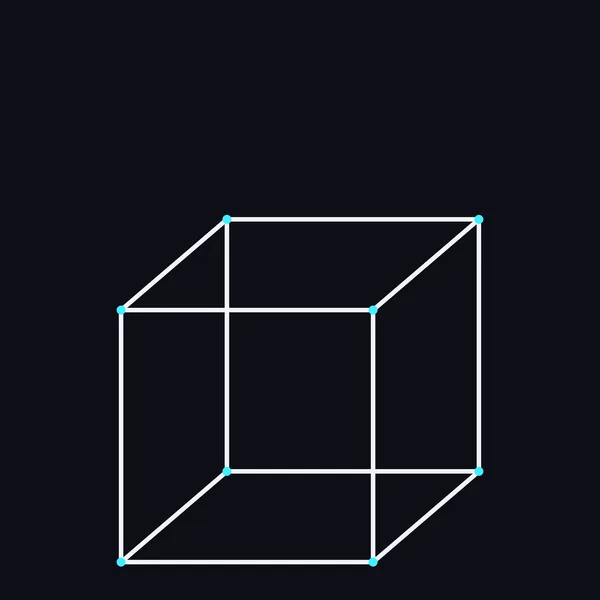 Impossible & ambiguous figuresNecker CubeA wireframe cube that flips between two orientations.
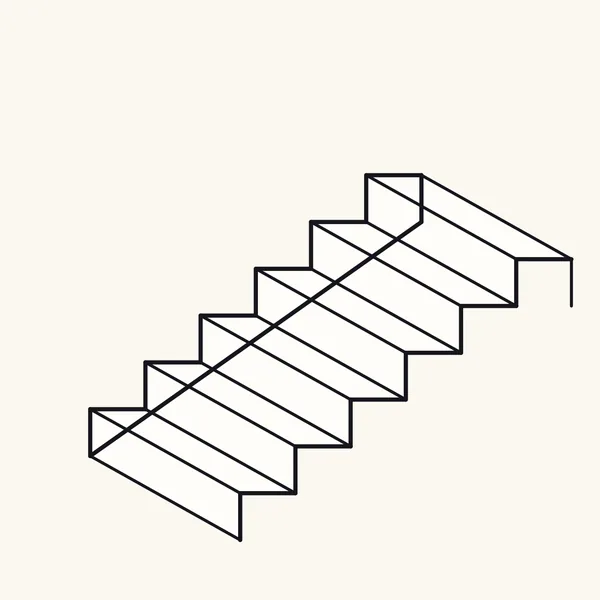 Impossible & ambiguous figuresSchröder StairsA staircase you climb from above or hang beneath from below.