
Yaakov's Ladder Illusion
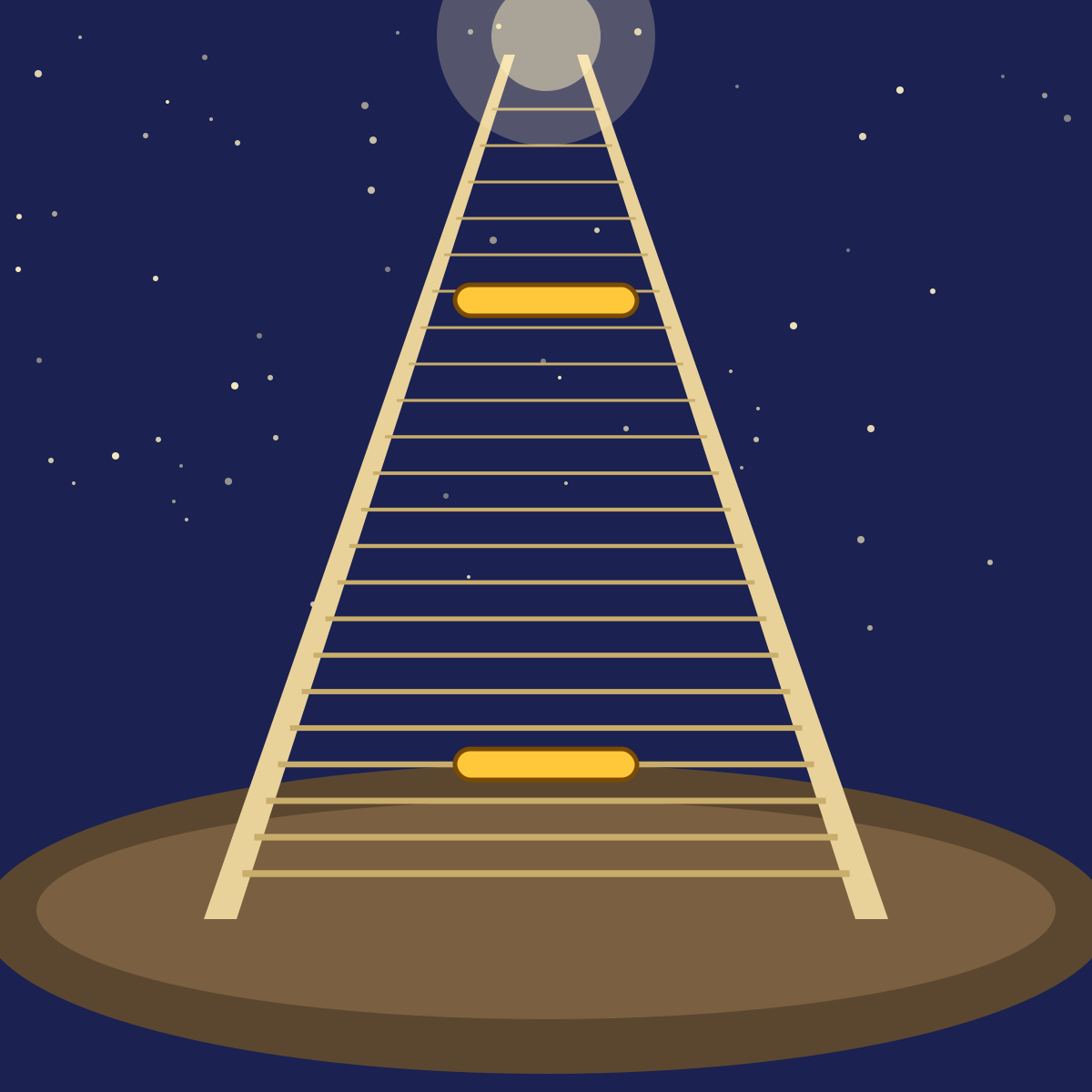
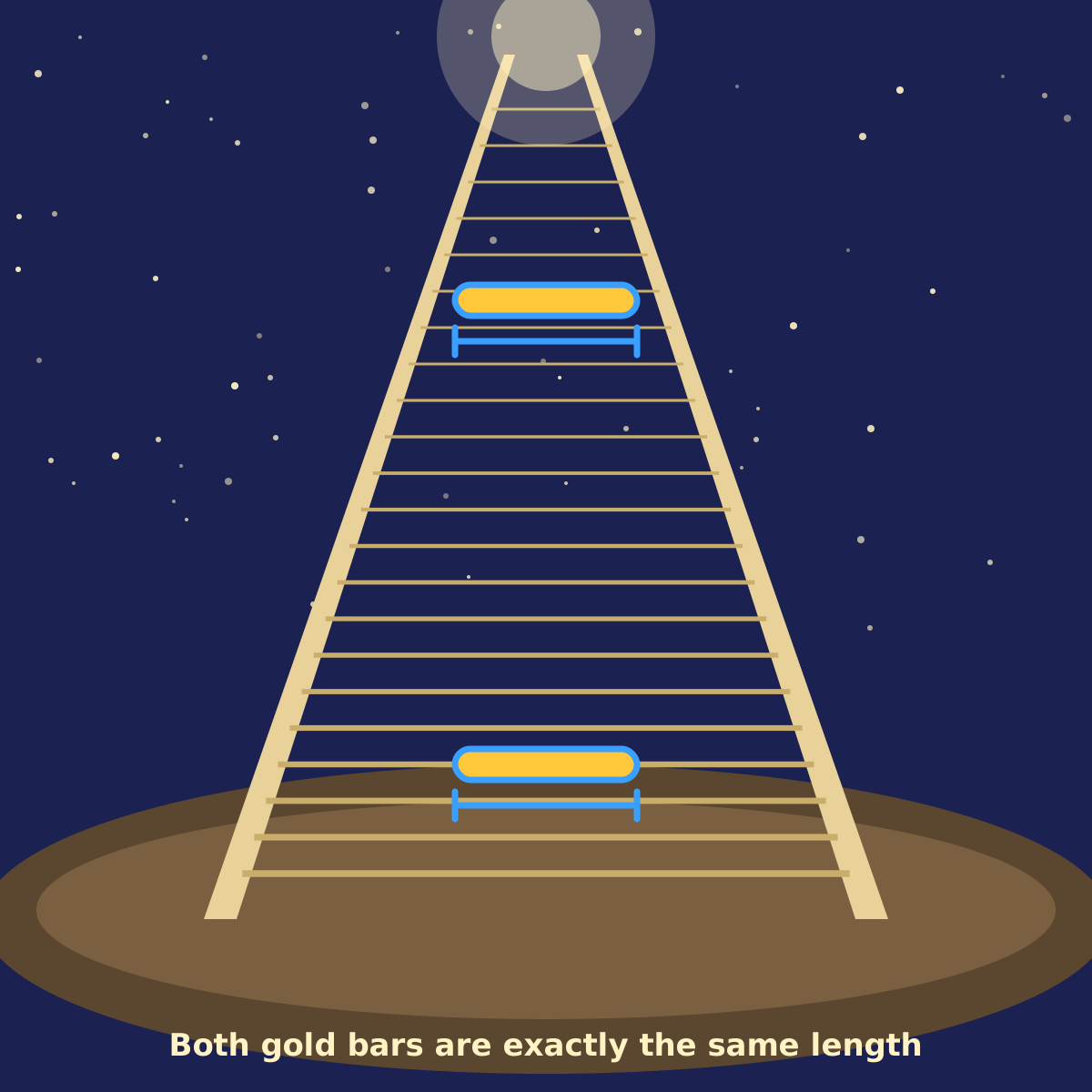
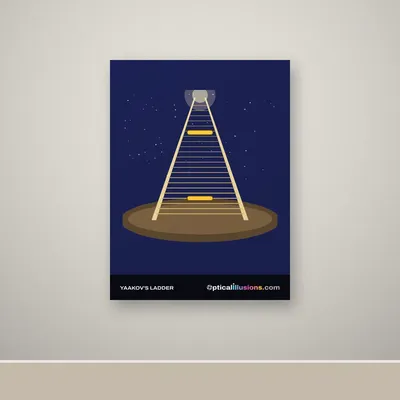
A ladder rises into the night sky with two gold bars on its rungs. The higher bar looks longer, but both are exactly the same length.
Get Yaakov's Ladder on a tee, mug or poster
Printed to order with the Opticalillusions.com wordmark. Or cover the challot with it this Shabbos.
What do you see?
A tall ladder stands on the earth at night and reaches up toward a glowing light in the sky, its two rails leaning toward each other as they climb. Two gold bars lie across its rungs, one low near the ground and one high near the heavens. The high bar looks clearly longer than the low one. Most people are sure of it, and many are surprised when told the truth: the two bars are exactly the same length.
How it works
This is the Ponzo illusion, described by the Italian psychologist Mario Ponzo in 1911. Two identical horizontal bars are placed between lines that slant toward each other, like railroad tracks running to the horizon. The bar sitting higher up, where the lines are closer together, looks longer than the bar lower down, where the lines are far apart.
The brain reads converging lines as perspective. In everyday life, lines that come together in the distance are usually parallel edges, such as a road or the sides of a ladder, and objects higher up between them are farther away. If two things throw the same size image onto the eye but one seems farther away, the brain concludes the far one must be bigger and stretches it in your perception. Here, the rails of Yaakov's ladder act exactly like a road vanishing into the sky.
Nothing in the drawing is actually bigger. Both gold bars have the same length, the same thickness and the same color. Only their surroundings differ. The rungs add to the effect, because the closely spaced rungs near the top look like a long staircase receding into the distance, which strengthens the sense of depth.
The Ponzo illusion is related to the Muller-Lyer illusion and the moon illusion, where the moon seems bigger near the horizon. All of them show that perceived size depends on perceived distance, not just on the size of the image on the retina. Researchers have found that the effect is a little weaker when you look at the picture with one eye closed and weaker still for people who grew up without much exposure to straight roads and buildings.
You can test it yourself: hold a strip of paper against the lower bar, then slide it to the upper one. The strip fits both exactly. Cover the rails with your hands and the bars suddenly look equal again.
History
Mario Ponzo published this illusion in 1911. Parashat Vayetzei (Genesis 28:10 to 32:3) is read on Shabbat, November 21, 2026. Yaakov leaves home, lies down to sleep with a stone for a pillow, and dreams of a ladder set on the ground whose top reaches the heavens, with angels going up and down it (Genesis 28:12). He wakes and says, "Surely the Lord is in this place, and I did not know it." The ladder in this drawing leans into the distance the same way a road does, which is what fools the eye.
Try it
- Look at both gold bars and decide which one is longer before you press the button.
- Press the reveal button: both bars get the same blue outline and the same measuring bar.
- Hold a strip of paper against the lower bar, then the upper bar. Does it fit both?
- At the Shabbos table, ask everyone to guess first. Who was fooled?
Sources & credits
Based on the Ponzo illusion (Mario Ponzo, 1911). The ladder, sky and bars are an original drawing.
- Ponzo, M. (1911). Intorno ad alcune illusioni nel campo delle sensazioni tattili, sull'illusione di Aristotele e fenomeni analoghi. Archivio Italiano di Psicologia.
- Ponzo illusion — overview Read →
- Vayetzei — overview Read →
Further reading: The Illusions Index (University of Glasgow) and Michael Bach’s Optical Illusions & Visual Phenomena.
Written by K.R. for Opticalillusions.com · Updated . Illusion artwork © The Wizard Of Sales, LLC. Feel free to share a link; see our terms for reuse.
Related illusions
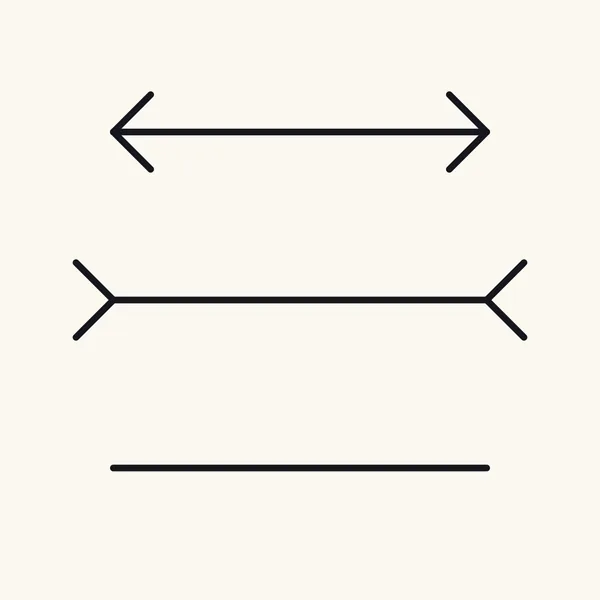 InteractiveGeometric illusionsMüller-Lyer IllusionThree identical lines that look clearly different in length.
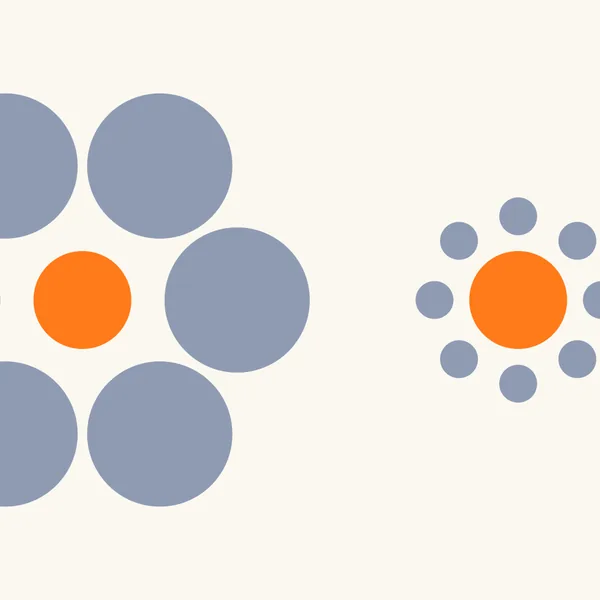 Geometric illusionsEbbinghaus IllusionA circle among giants looks small; among dwarfs it looks big.
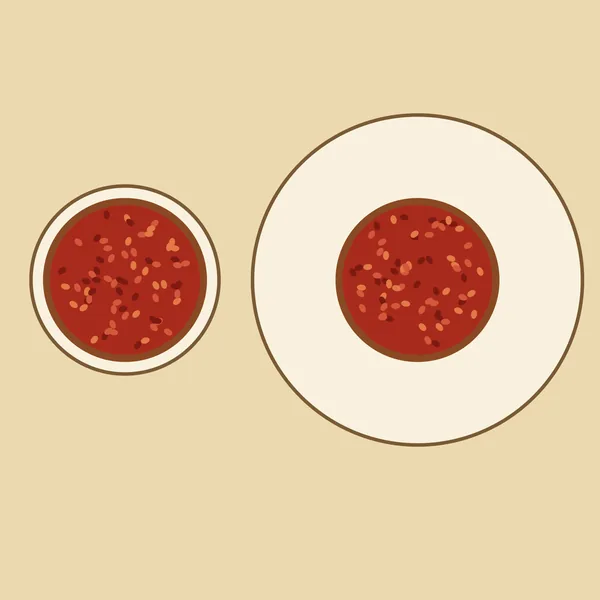 Shabbos & Yom Tov Illusion of the WeekTwin Bowls of Toldot IllusionTwo bowls of red lentil stew, one in a snug plate and one in a wide plate. They look different, but they are exactly the same size.
 Shabbos & Yom Tov Illusion of the WeekRivka's Well IllusionLook down into Rivka's well: the rope seems to spiral down to the water, yet every coil is a perfect circle.