
Lilac Chaser
A ring of lilac blurs where a green dot seems to race around, and then the lilac vanishes.
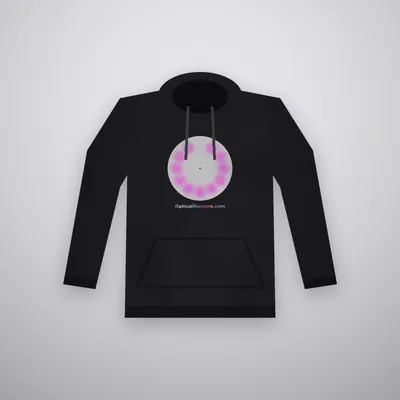

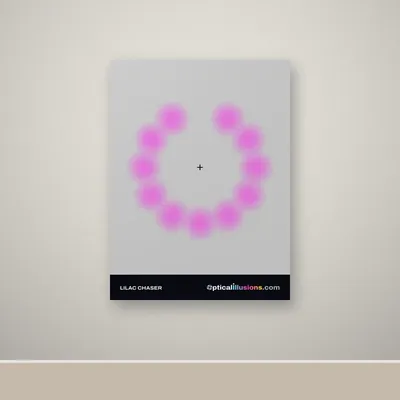
Get this illusion on a hoodie, mug or poster
Lilac Chaser, printed to order with the Opticalillusions.com wordmark.
What do you see?
Press Play and keep your eyes on the black cross in the center. Twelve soft lilac discs sit in a ring, and one at a time they disappear for a moment, so the gap seems to travel around the ring. Within a few seconds, most people see a green dot racing around the circle in place of the gap. Keep staring and the lilac discs fade away altogether, leaving only a single green dot spinning around on gray. Move your eyes and the lilac comes back.
How it works
The lilac chaser combines three effects: a negative afterimage, Troxler fading and apparent motion.
The green dot is a negative afterimage. Color vision depends on opposing channels, and lilac (a mix of red and blue light) mainly drives one side of the red-green channel. When you stare at a lilac disc, the cells signalling that color adapt and become less responsive. When the disc disappears, the adapted cells respond more weakly than their opponents, and you briefly see the complementary color, which is green. Because each disc vanishes in turn, a green afterimage appears at each empty position.
The motion is apparent motion. When something appears at one position and then a moment later at the next, your brain links the events and sees a single object moving. This is the same principle that makes film work. The green afterimages appear one after another around the ring, so they are seen as one green dot traveling.
The fading of the lilac discs is Troxler fading. When you keep your eyes still, unchanging and blurry images in peripheral vision fade from awareness, because neurons adapt to steady input. The discs here are deliberately soft-edged and placed away from the center, which makes them fade quickly. Once the lilac has faded, the only thing still changing is the green afterimage, so it is all you see.
All three effects depend on keeping your eyes still. Every time you move your gaze, the image lands on fresh, unadapted cells, the lilac returns and the green dot disappears for a while. That is why the instruction to look only at the cross matters so much.
The colors were chosen carefully. Lilac on a mid-gray background gives a clear green afterimage, and the soft edges help the fading. Other color combinations work too: with blue discs, for example, the afterimage is yellowish.
History
The lilac chaser was created by Jeremy Hinton around 2005 and became widely known after it was posted online and featured by vision scientist Michael Bach on his site of optical illusions. The version on this page is an original animation drawn for Opticalillusions.com using the same principle.
Try it
- Look only at the cross for 20 to 30 seconds without moving your eyes.
- Notice the moment the gap turns green, and the moment the lilac disappears.
- Move your eyes away and back: watch the lilac return.
- Pause the animation after staring: the green dot stops, then fades.
Frequently asked questions
Is there really a green dot in the lilac chaser?
No. The green dot is an afterimage. When each lilac disc disappears, tired color cells make you briefly see the opposite color, green.
Why do the lilac discs disappear?
When you keep staring at the cross, the soft discs fade away through Troxler fading. Move your eyes and the lilac comes back.
Why does the green dot seem to move?
The green afterimages appear one after another around the ring, and your brain links them into a single moving dot. This apparent motion is the same principle that makes film work.
Who created the lilac chaser?
Jeremy Hinton created it around 2005. It became widely known after vision scientist Michael Bach featured it on his site of optical illusions.
Sources & credits
Created by Jeremy Hinton (about 2005); our animation is an original version of the same principle.
- Michael Bach — Optical Illusions & Visual Phenomena (where the lilac chaser became widely known) Open →
- Lilac chaser — overview Read →
Further reading: The Illusions Index (University of Glasgow) and Michael Bach’s Optical Illusions & Visual Phenomena.
Written by K.R. for Opticalillusions.com · Updated . Illusion artwork © The Wizard Of Sales, LLC. Feel free to share a link; see our terms for reuse.
Related illusions
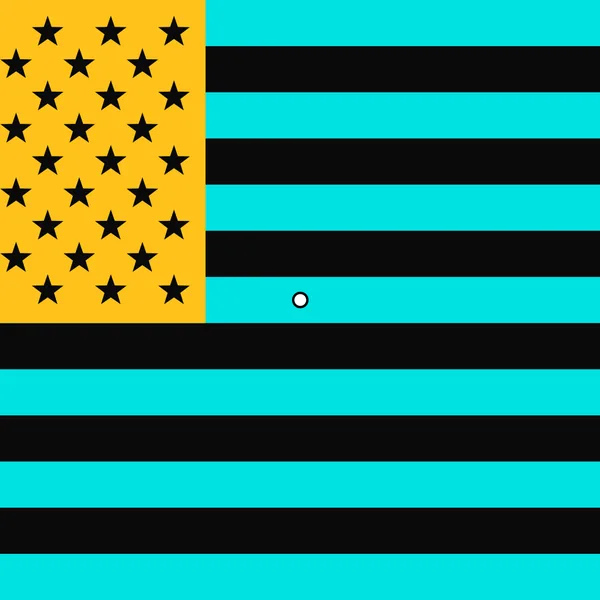 InteractiveColor illusionsAfterimage FlagStare at a cyan, black and yellow flag and a red, white and blue one appears.
 InteractiveMotion illusionsTroxler FadingStare at the cross and the soft color spots vanish into gray.
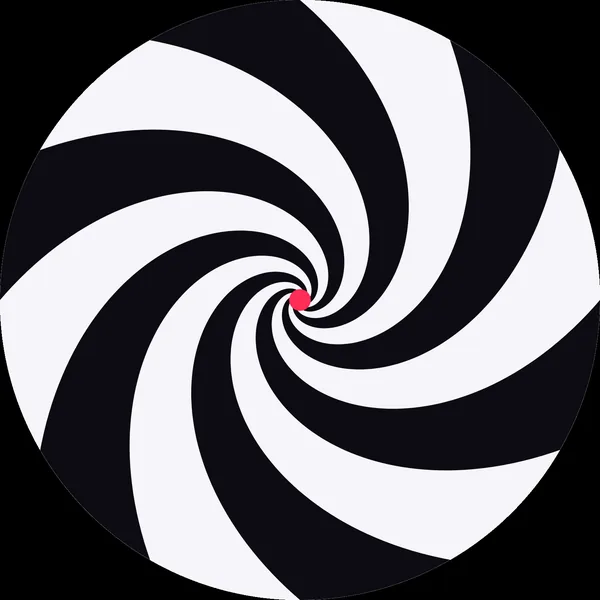 InteractiveMotion illusionsMotion Aftereffect SpiralWatch a spinning spiral for 30 seconds and still things start to move.
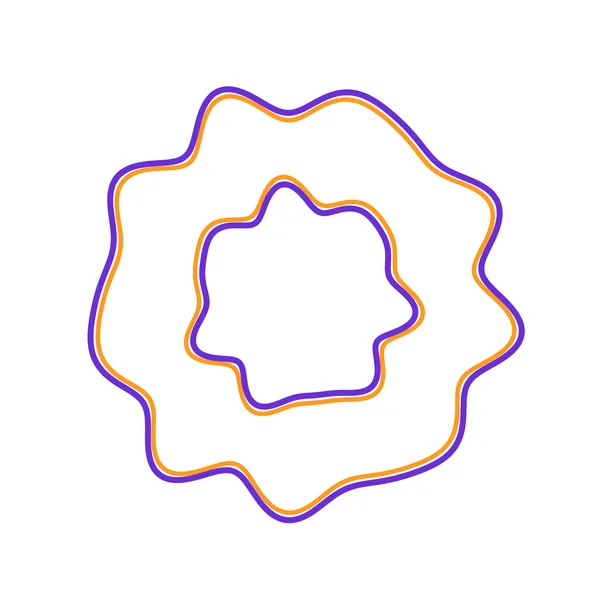 Color illusionsWatercolor IllusionA thin orange edge tints a whole white region pale orange.