
How Magic Eye Pictures Work (and How to See Them)
A Magic Eye picture looks like a busy wallpaper pattern until a 3D shape suddenly floats out of it. Here is what is really going on between your eyes and your brain, and how to see one even if you never could before.
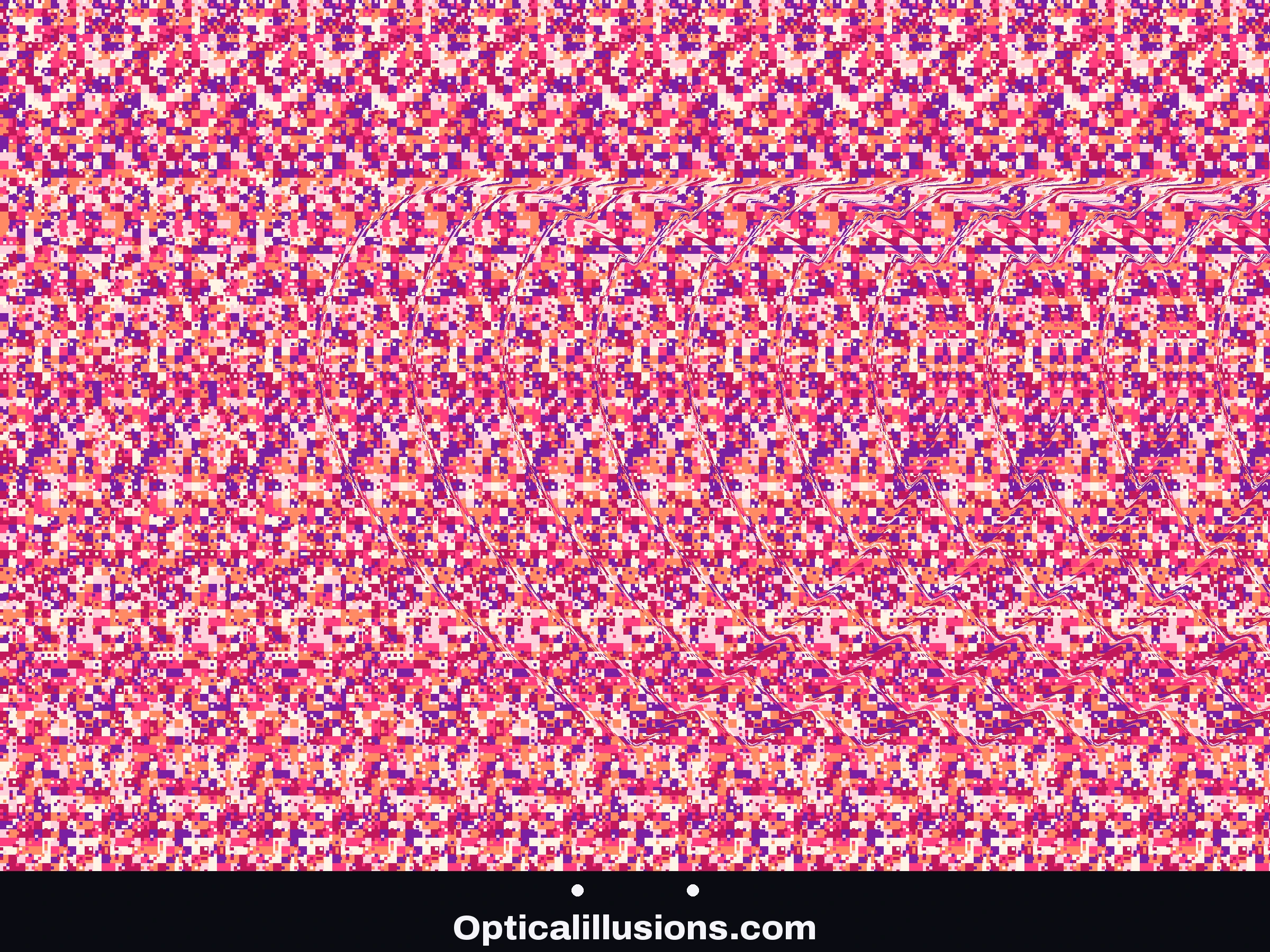
The short answer
A Magic Eye picture is a type of stereogram: a flat picture with a hidden 3D shape inside it. It works because you have two eyes. Each eye sees the world from a slightly different spot, about two and a half inches apart, and your brain uses the tiny differences between the two views to work out how far away things are. That skill is called stereopsis, or stereo vision.
A stereogram tricks that skill. It is built from a pattern that repeats across the page. Where the hidden shape should be, the pattern repeats a little closer together. When you point your eyes at two neighboring copies of the pattern instead of the same spot, your brain compares them, notices that some parts are spaced closer than others, and reads those parts as nearer to you. The shape rises out of the page, even though the paper or screen is perfectly flat.
The technical name for a single-image stereogram is an autostereogram: "auto" because you do not need special glasses or a viewer. Magic Eye is a brand name for a popular series of them.
How your eyes measure depth
Hold a finger up in front of your face and close one eye, then the other. Your finger seems to jump sideways against the background. That jump is the difference between your two eyes' views, and it is bigger for things that are close and smaller for things that are far away. Your brain matches up the same object in both views, measures how far it has shifted, and turns that shift into a feeling of depth.
This was first explained clearly by the English scientist Charles Wheatstone in 1838. He drew two slightly different pictures, one for each eye, and showed them through a mirror device he called a stereoscope. People saw a single solid object instead of two flat drawings. The View-Master toy and modern 3D movies use the same idea: give each eye its own picture and let the brain combine them.
The random-dot surprise
For a long time, many scientists assumed you had to recognize an object in each eye's view before your brain could match the two. In 1959 the vision scientist Bela Julesz, working at Bell Laboratories, tested this with pairs of computer-made pictures covered in random dots. Each picture on its own was just noise. But in one of them, a patch of dots had been shifted slightly to the side. When people viewed the pair in a stereoscope, a floating square popped out of the dots.
That showed the brain can find depth by matching tiny details between the eyes, before it knows what the object is. Julesz published the work in the Bell System Technical Journal in 1960, and random-dot stereograms became a standard tool in vision research.
From two pictures to one
A classic stereogram still needs two pictures and a viewer. The leap to a single picture came in 1979, when Christopher Tyler, a vision scientist who had worked with Julesz, and programmer Maureen Clarke used a home computer to make the first black-and-white random-dot autostereogram. The idea combined Julesz's random dots with an older trick: in 1844 the Scottish scientist David Brewster noticed that staring at a repeating wallpaper pattern with his eyes unfocused could make the wallpaper seem to float in front of or behind the wall.
In 1991 engineer Tom Baccei and artist Cheri Smith created the first full-color random-dot autostereograms, which became the Magic Eye books and posters of the 1990s. You can read the company's own history in the Magic Eye FAQ.
How the hidden shape is made
To build a stereogram, a computer starts with two ingredients:
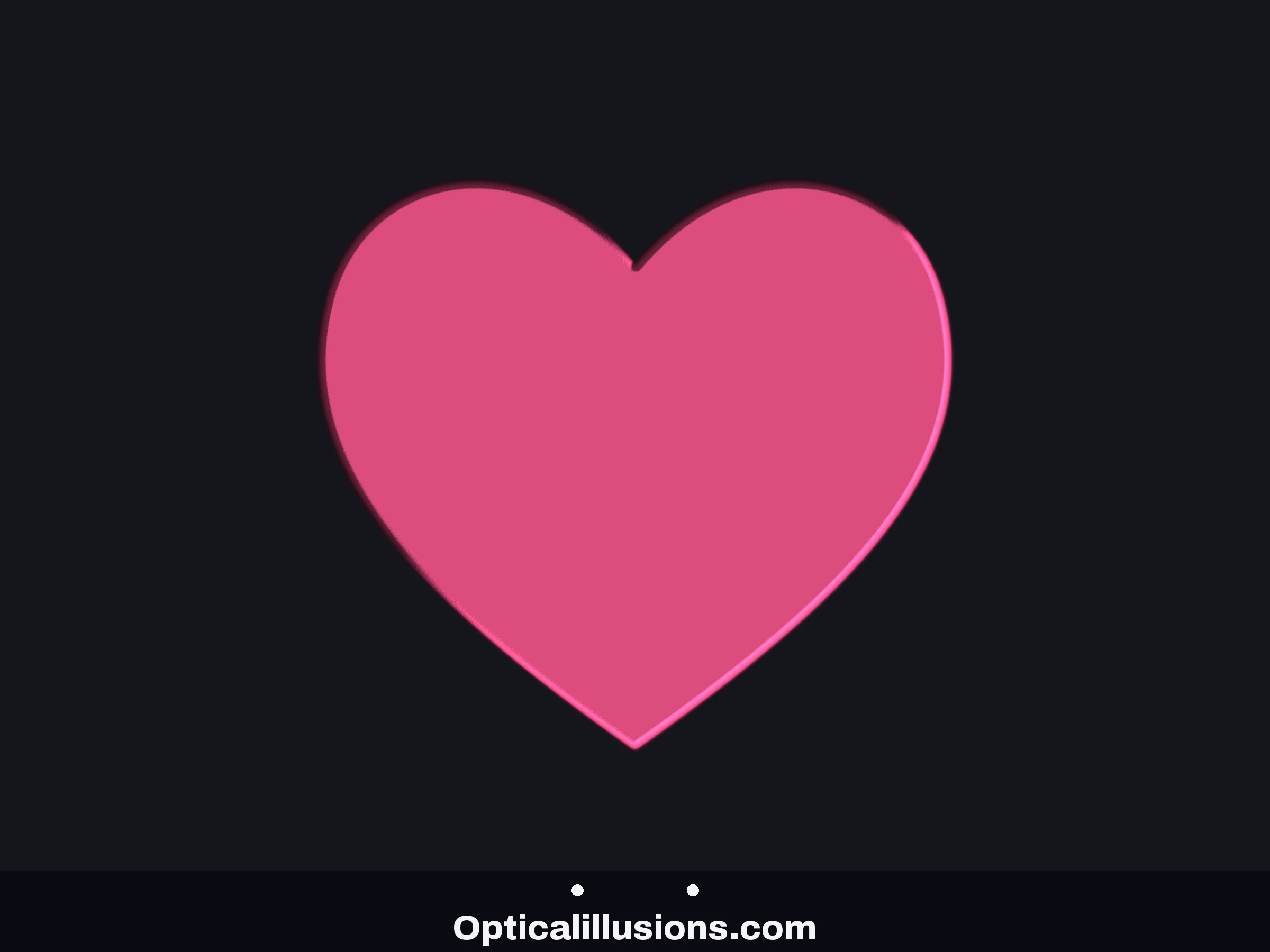
- A depth map, a gray picture of the hidden shape where white means near and black means far.
- A pattern strip, a narrow band of random dots or texture that will repeat across the picture.
The computer copies the pattern across each row. Wherever the depth map says "near," it repeats the pattern a few pixels sooner; wherever it says "far," it waits a little longer. The changes are too small to spot by looking normally, so the picture just looks like wallpaper. Only when your two eyes lock onto neighboring repeats does the spacing turn into depth. Our own stereograms are made exactly this way, which is why each one has a Reveal button that shows you the depth map.
Why you have to "look through" the picture
Normally your eyes do two things together. They aim (both eyes turn to point at the same spot) and they focus (the lens in each eye adjusts to make that spot sharp). For something close, your eyes turn inward and focus near; for something far away, they point almost straight ahead and focus far. These two actions are so closely linked that you never think about them.
A stereogram asks you to pull them apart. Most stereograms, including ours, are designed for wall-eyed or parallel viewing: you aim your eyes as if at a point behind the page, so that the left eye lands on one copy of the pattern and the right eye on the next copy over, while still keeping the page in focus. That is an unusual thing to ask of your eyes, and it is why the trick can take a few tries.
Some stereograms are made for cross-eyed viewing instead, where you aim your eyes at a point in front of the page. If you view a wall-eyed stereogram cross-eyed, the shape usually appears sunk into the page instead of raised, a sign you have the right idea but the wrong direction.
How to see a stereogram, step by step
These steps work for most people. Give yourself a few minutes and do not strain.
- Make it big and bright. Open the picture full screen or print it large. Good light makes focusing easier.
- Use the guide dots. Our stereograms have two white dots in the strip at the bottom. Look between them and let your eyes relax as if staring at something far away. The two dots will double into four.
- Make three dots. Keep relaxing until the middle two dots slide together into one, so you see three in a row. Hold that feeling.
- Look up slowly. Without changing what your eyes are doing, move your gaze up into the pattern. After a few seconds it seems to split into layers and the shape floats out.
- Try the nose trick. Hold a printed picture against your nose so everything is blurry, then move it away very slowly without trying to focus.
- Try the reflection trick. On a glossy screen, focus on your own reflection, then let the pattern come into focus behind it.
Once the shape appears, you can usually look around it and it stays. Blink or refocus and it disappears; relax again and it comes back. Our step-by-step guide on the stereograms page has the same steps next to six pictures you can practice on, from an easy star to a rocket with several depth levels.
Why some people cannot see them
If you have tried and tried, you are not alone, and there is usually a good reason. Seeing a stereogram needs both eyes to work together closely. People with amblyopia (often called lazy eye), a turned eye or other differences in how the two eyes team up may have weak stereo vision or none, a condition called stereoblindness. For them a stereogram stays flat no matter what they do. The Wikipedia article on autostereograms summarizes this research and its sources.
Other common reasons are simpler: a small screen, tired eyes, or reading glasses or progressive lenses that make the focusing step harder. Try with and without your glasses, and try again on another day. If you notice that you cannot see depth in other situations either, such as 3D movies, it is worth mentioning to an eye doctor.
Stereograms are not harmful to your eyes. Some people feel mild eye strain or a brief headache after a long session, so take breaks and stop if it feels uncomfortable.
Make your own 3D weather picture
Want to see a stereogram that changes every day? Our Weather 3D tool turns the weather for your ZIP code into a hidden 3D picture: the temperature, a clothing tip and a weather icon are buried in the dots, and rain or snow can even fall in front of the picture. It uses the same depth-map method described above, and the Show answer button lets you check what you found.
If you enjoy the feeling of your brain building a shape out of almost nothing, you may also like the Kanizsa triangle, where your brain draws edges that are not there, and the Necker cube, which flips between two 3D shapes on its own. Our guide to the types of optical illusions explains how these families fit together.
Try it yourself
Start with the heart or the star, which have one simple raised shape, then move on to the butterfly and the rocket. Each picture has a download button, so you can print one and practice away from the screen.
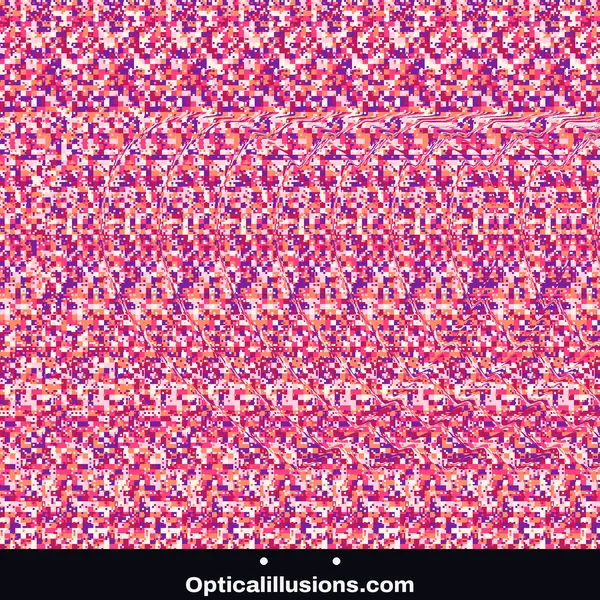 InteractiveStereogramsHidden Heart StereogramA plump 3D heart floats in front of a pink and red pattern.
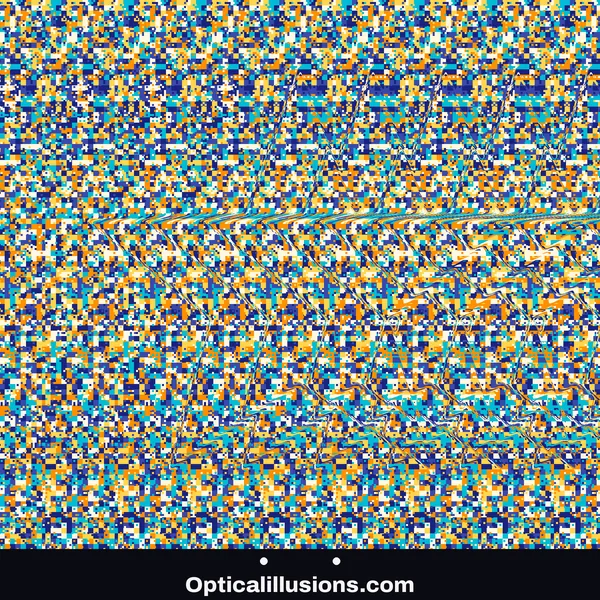 InteractiveStereogramsHidden Star StereogramA five-pointed 3D star hides in a gold and navy pattern.
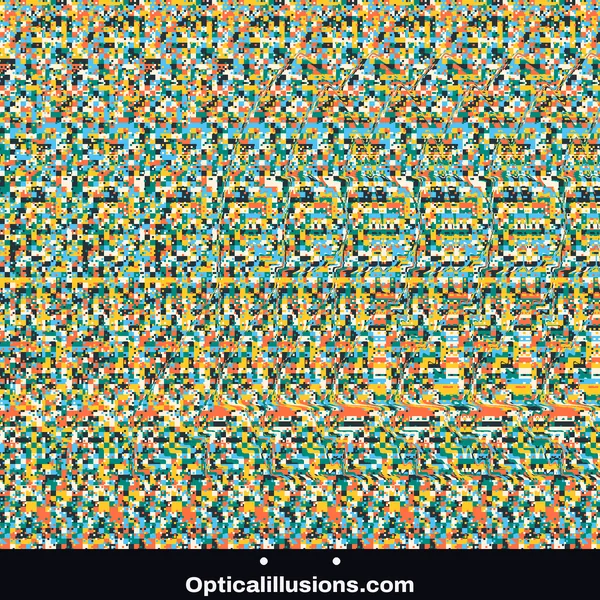 InteractiveStereogramsHidden Rocket StereogramA 3D rocket with fins and a round window waits in a teal and orange pattern.
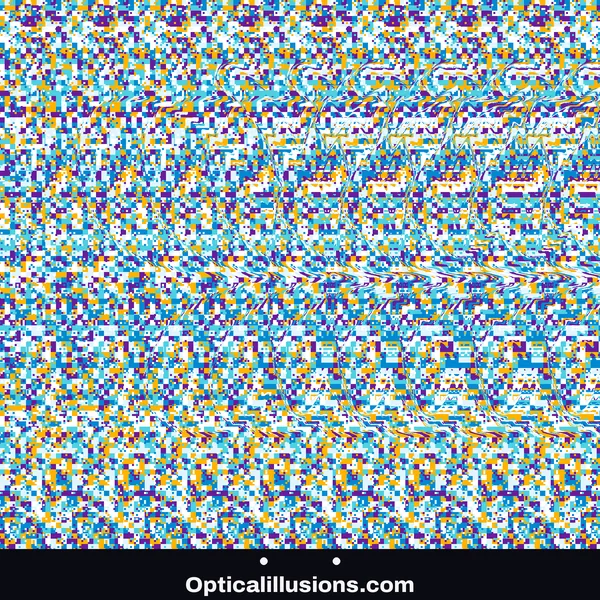 InteractiveStereogramsHidden Butterfly StereogramA 3D butterfly with bold wings is hidden in a bright blue and gold pattern.
Questions and answers
How do Magic Eye pictures work?
They hide a 3D shape in a repeating pattern. Where the shape should stand out, the pattern repeats slightly closer together. When your two eyes aim at neighboring copies of the pattern, your brain reads the closer spacing as nearer, and the shape seems to float off the page.
Who invented the Magic Eye picture?
Random-dot stereograms were invented by vision scientist Bela Julesz at Bell Laboratories in 1959. Christopher Tyler and Maureen Clarke made the first single-image version in 1979, and Tom Baccei and Cheri Smith created the color Magic Eye pictures in 1991.
Why can't I see Magic Eye pictures?
Seeing one needs both eyes to work together closely. People with weak stereo vision, for example from amblyopia, may not be able to see the shape at all. For everyone else it is usually a matter of practice, a bigger picture and a relaxed, far-away gaze.
Are Magic Eye pictures bad for your eyes?
No. They do not damage your eyes. A long session can cause mild eye strain, so take breaks and stop if you feel uncomfortable.
Enjoyed this? Get a new illusion every week
One original illusion in your inbox each week, with the science explained in a minute.
Written by the Opticalillusions.com team · Published . Illusion artwork © The Wizard Of Sales, LLC. Spotted an error? Tell us.
More from Learn
 Learn · Guide15 Famous Optical Illusions and the Stories Behind ThemFrom the Necker cube of 1832 to the dress of 2015: the famous illusions everyone should know, who made them and why they work.
 Learn · GuideThe Penrose Triangle and Other Impossible Objects, ExplainedWhy the impossible triangle, cube and fork look solid but could never be built, and how artists fake them in real life.
 Learn · GuideWhy Ambiguous Pictures Flip: The Rabbit-Duck, Rubin Vase and MoreA rabbit or a duck? A vase or two faces? Why two-answer pictures flip, why you never see both, and how to switch on purpose.
 Learn · GuideAfterimage Illusions: Why You See Colors That Aren't ThereStare, look away, and a ghost picture appears in opposite colors. How afterimages work and why they flip red to cyan and blue to yellow.
 Learn · GuideBlind Spot Test: Find the Hole in Your Vision in One MinuteMake a dot vanish and a broken line repair itself. A one-minute test for the blind spot every eye has, and why you never notice it.
 Learn · Guide9 Easy Optical Illusions You Can Do at HomeA floating finger, a hole in your hand, a rubber pencil and more: nine illusions you can do with things you already have.
 Learn · GuideHow to Draw Optical Illusions: 4 Easy Step-by-Step IdeasFour easy illusions anyone can draw with a pencil, ruler and marker, with step-by-step pictures and the science behind each trick.
 Learn · GuideWhat Is Op Art? Optical Illusion Art ExplainedPaintings that ripple, bulge and buzz: how 1960s op artists used lines, grids and color to trick the eye, and how to make your own.
 Learn · GuideAre Optical Illusions Bad for Your Eyes? Facts and MythsDo illusions hurt your eyes? The facts on eye strain and dizziness, who should take care with flashing patterns, and the viral myths.
 Learn · GuideWhy Do Optical Illusions Work? How Your Brain GuessesSeeing is a best guess. The six shortcuts your brain uses, and the illusions that catch each one, explained in plain words.
 Learn · GuideWhy Do Still Pictures Seem to Move? Motion Illusions ExplainedDrifting snakes, wobbling checks and spinning rings: how your eye movements and motion cells turn flat pictures into motion.Learn · GuideOptical Illusion Science Fair Projects: 8 Ideas That WorkEight testable project ideas, from measuring the Müller-Lyer illusion to timing afterimages, with tips on fair tests and fair rules.
 Learn · GuideTypes of Optical Illusions, Explained (With Examples)Literal, physiological and cognitive illusions, plus motion, color, geometric, ambiguous, impossible and afterimage illusions, with an example of each.
 Learn · GuideWhy Colors Trick Your Eyes: The Science of Color IllusionsColor constancy, simultaneous contrast, the Munker illusion and afterimages: how your brain builds color, and why it sometimes gets it wrong.
 Learn · GuideThe Dress: Why Everyone Saw It DifferentlyBlue and black or white and gold? The 2015 photo, the lighting assumptions behind it and what scientists found when they studied it.