
Why Do Still Pictures Seem to Move? Motion Illusions Explained
Some pictures seem to crawl, spin or ripple even though nothing on the page moves at all. The motion is made inside your own visual system. Here are the main tricks behind it, in plain words.
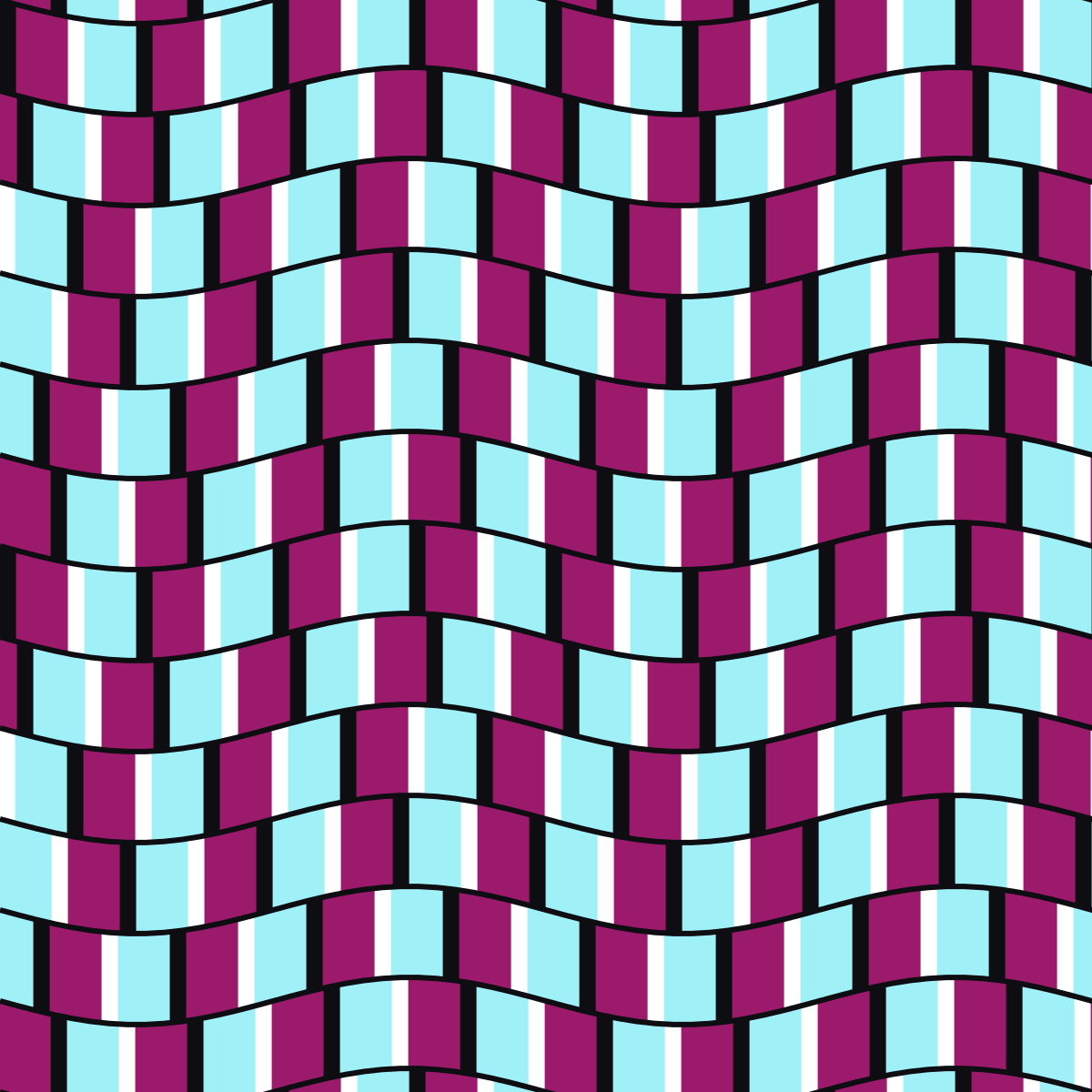
Nothing is moving, but you see motion
Open our peripheral drift illusion and let your eyes wander. The wavy bands at the edge of your vision seem to creep sideways like conveyor belts. Look straight at one band and it stops. It is a still picture: no animation, no hidden video. So where does the motion come from?
The answer is that motion is not something your eyes simply record. Your brain works it out, using cells that compare what happens at nearby spots from one moment to the next. Those cells are fast and sensitive, which is great for spotting a ball flying toward you. But they can be fooled. Motion illusions are pictures that send these cells the same kind of signal real movement would, even though the picture is still.
Scientists group the causes into a few main tricks. Most motion illusions use one or more of them.
Trick 1: your eyes never stop moving
Even when you think you are staring perfectly still, your eyes are moving. They make tiny jumps called microsaccades, slow drifts and small tremors, plus ordinary blinks and glances. You do not notice these movements because your brain cancels them out: it knows the world did not jump, your eyes did.
That cancelling is not perfect. Some patterns are designed so that every tiny eye movement produces a strong, confusing motion signal that the brain fails to cancel. The result is motion that seems to come from the picture itself. A 2012 study in the Journal of Neuroscience by Jorge Otero-Millan, Stephen Macknik and Susana Martinez-Conde recorded people's eye movements while they viewed Rotating Snakes and found that microsaccades and blinks were closely linked to the moments when people reported the snakes turning (read the study).
This is why many motion illusions work best when you let your eyes roam, and why they weaken if you hold your gaze very steady.
Trick 2: some signals arrive sooner than others
The peripheral drift illusion adds a second ingredient: timing. Its bands repeat four brightness steps in the same order, such as black, dark, white and light. Your visual system does not process every contrast at the same speed. Strong contrasts are signaled slightly faster than weak ones.
When the pattern lands on your retina, or gets refreshed by an eye movement or blink, the fast and slow signals arrive a split second apart. Motion detectors in the brain read a "this spot, then the next spot" sequence as movement, so the delay looks like the band sliding from one brightness step to the next. In a 2005 study in the Journal of Neuroscience, Bevil Conway, Akiyoshi Kitaoka and colleagues found that motion-sensitive neurons in monkeys responded to these stepped patterns, and that the illusion works even without color, as long as the order of brightness stays the same (read the study).
Why only in the corner of your eye?
Your central vision is very good at checking whether something has really moved, and it vetoes the false signal. Peripheral vision is blurrier but very sensitive to motion, so the drift survives there. That is why the bands you look straight at sit still while the ones around them keep creeping.
A short history
Alex Fraser and Kimerley Wilcox described drifting motion in a still sawtooth pattern in 1979. Jocelyn Faubert and Andrew Herbert studied it further in 1999 and named it the peripheral drift illusion. In 2003 the Japanese psychologist Akiyoshi Kitaoka, with Hiroshi Ashida, published the stepped-brightness design that made his Rotating Snakes one of the best-known illusions in the world. The design on our page is our own artwork built on the same principle.
Trick 3: the brain cannot tell which way a line slides
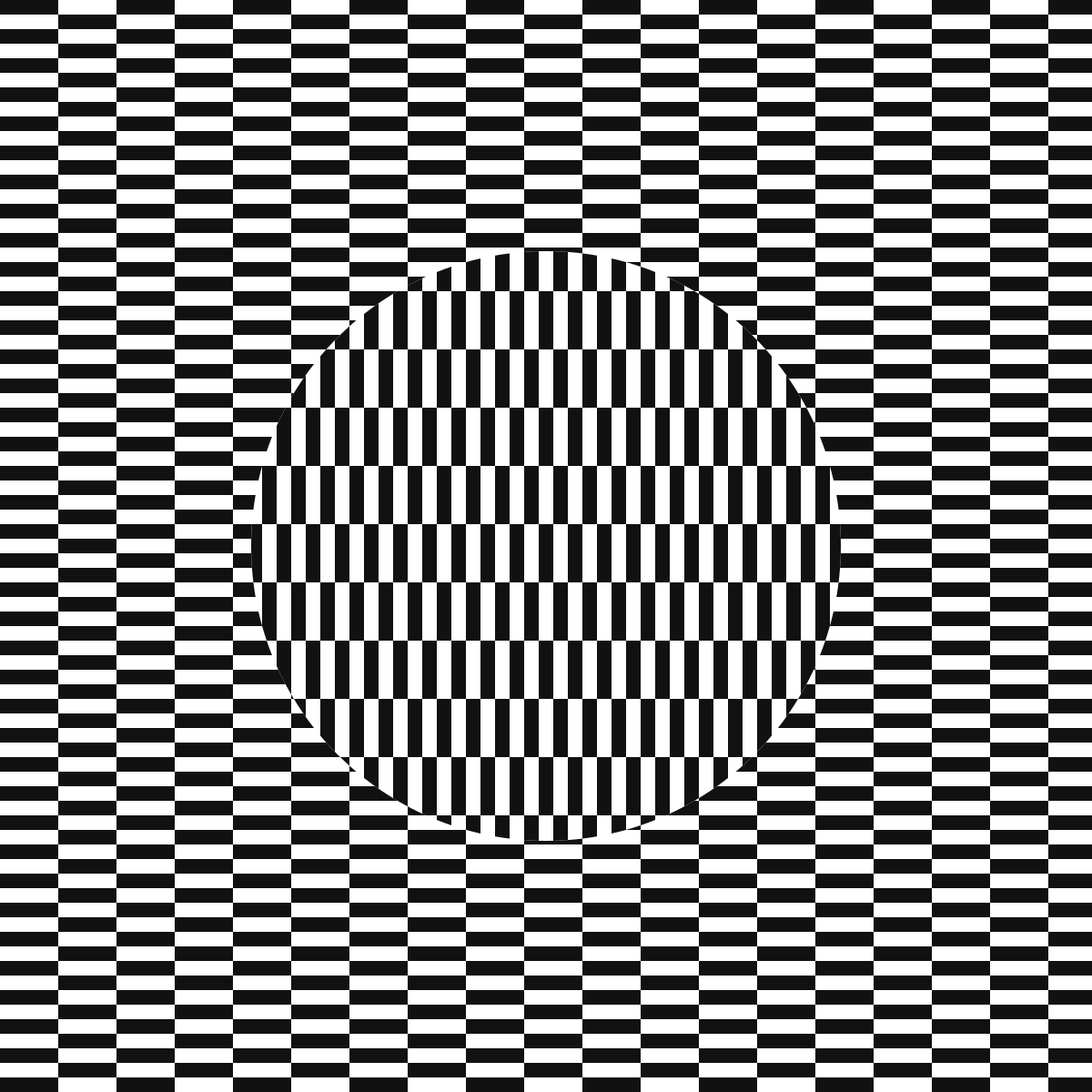
Look at the Ouchi illusion: a central disc of checks running one way, set in a background of checks running the other way. Move your eyes or your head a little and the disc seems to float and slide on its own, as if it were a separate layer.
The explanation lies in how motion cells see. Each one looks at a small patch of the picture. If that patch contains only a long edge, the cell can tell how the edge moves across itself, but not how it slides along its own length. Scientists call this the aperture problem. In the Ouchi pattern, the small eye movements you make shift the two sets of checks in ways your motion cells measure differently, because their edges point in different directions. Your brain concludes that the disc and the background are moving separately. The illusion is named after the Japanese artist Hajime Ouchi, who published the pattern in 1977.
The Pinna-Brelstaff rings use a related trick. Move your head toward the screen while looking at the center and the two rings seem to rotate in opposite directions. The slanted pieces in each ring send motion signals that point partly sideways, and your brain adds them up into a turning motion. Baingio Pinna and Gavin Brelstaff described the effect in 2000.
Trick 4: tired motion cells
Your brain has motion cells tuned to different directions: some respond to upward motion, some to downward, some to things growing larger, some to things shrinking. When the world is still, these groups are in balance.
Watch steady motion for a while and the cells tuned to that direction get tired and quiet down. When the motion stops, the rested cells for the opposite direction win, and still things seem to move the other way. This is the motion aftereffect. Robert Addams described it in 1834 after watching the Falls of Foyers in Scotland: when he looked away from the falling water, the rocks beside it seemed to drift upward. That is why it is also called the waterfall illusion.
You can try it with our motion aftereffect spiral. Watch it spin for 30 seconds, then look at your hand, and your hand seems to swell or shrink. The effect is strongest in the part of your vision the spiral covered, which shows it comes from cells that look at small patches of space.
Trick 5: motion that builds a shape
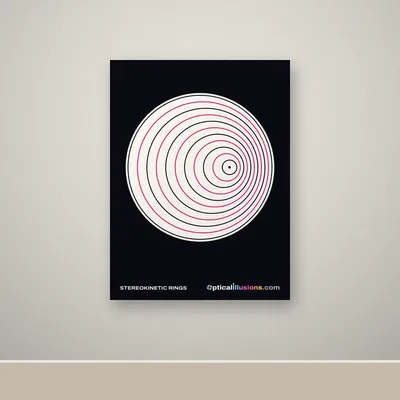
Some illusions use real motion but make your brain see something that is not there. In our stereokinetic rings, flat circles simply turn on the screen, yet most people see a 3D cone or tunnel bobbing toward them. Your brain prefers to see a solid object turning in depth over a set of flat circles sliding over each other. The spinning dot globe works in a similar way: a flat pattern of moving dots reads as a turning ball, and the direction of spin can flip because the picture has no clue about which side is in front.
The opposite trick: still things that vanish
Your visual system cares so much about change that if nothing changes, it can stop reporting things altogether. In Troxler fading, described by Ignaz Troxler in 1804, a soft, blurry shape in the corner of your vision fades away if you hold your gaze steady on a center point. Blink or move your eyes and it returns. This is the flip side of the motion illusions above: eye movements that create false motion in one picture are also what keep the world from fading in normal life.
Why some people see more motion
Motion illusions vary from person to person. Some people see fast, strong motion in Rotating Snakes, while a few see very little. The effect is often weaker on a dim or small screen, and when you are tired. Since eye movements help trigger the motion, differences in how people's eyes move during fixation may also play a part. If an illusion makes you feel dizzy or queasy, look away and take a break.
For the bigger picture of how these shortcuts fit with the rest of vision, read why optical illusions work, or browse every picture in our motion illusions collection. If you are looking for an experiment, measuring how screen brightness changes the drift is one of our optical illusion science fair projects.
Try it yourself
Open each illusion below full screen. For the drift and Ouchi patterns, let your eyes wander. For the rings, move your head toward and away from the screen. For the spiral, follow the 30-second instructions on the page.
 Motion illusionsPeripheral Drift IllusionWavy bands that slide sideways in the corner of your eye, even though nothing moves.
 Motion illusionsOuchi IllusionA checkered disc that seems to float and slide over its background.
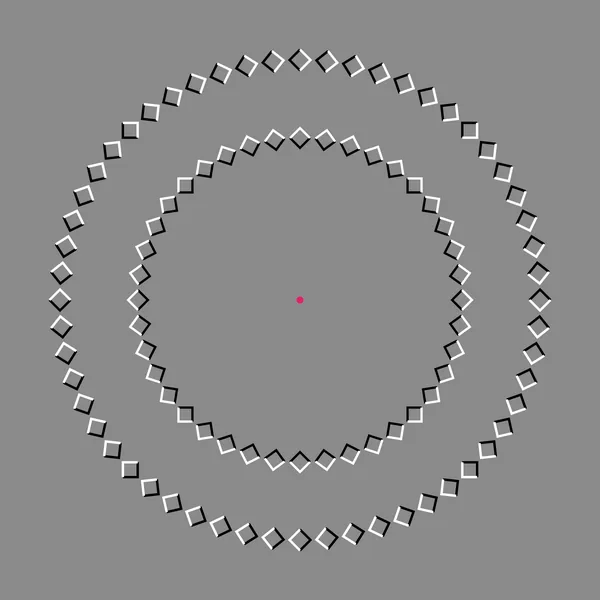 Motion illusionsPinna-Brelstaff RingsMove your head toward the dot and the two rings turn opposite ways.
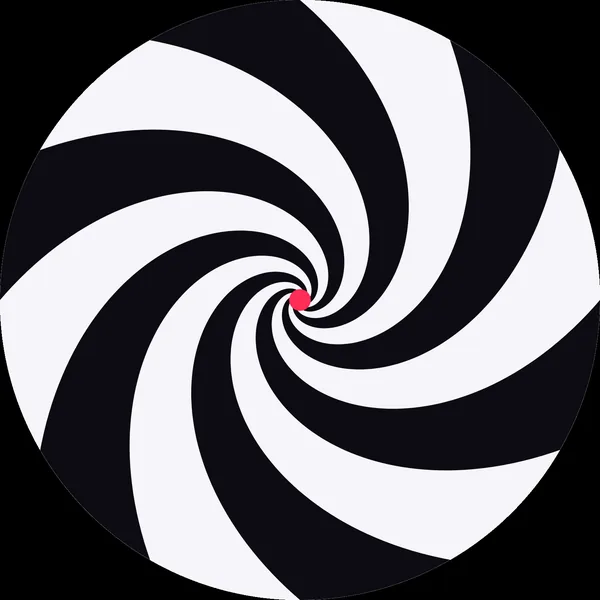 InteractiveMotion illusionsMotion Aftereffect SpiralWatch a spinning spiral for 30 seconds and still things start to move.
Questions and answers
Why do some still images look like they are moving?
Your brain works out motion from signals that change over time. Some patterns are designed so that tiny eye movements, blinks and small timing differences in how your eyes signal light and dark produce the same kind of signal real motion would, so the brain reports movement in a still picture.
Why does the motion stop when I look straight at it?
Central vision is very good at checking that nothing has really moved, so it vetoes the false signal. Peripheral vision is blurrier but more sensitive to motion, so the drift survives at the edges of your view.
Who created the Rotating Snakes illusion?
Rotating Snakes was created by the Japanese psychologist Akiyoshi Kitaoka in 2003, building on earlier work by Fraser and Wilcox in 1979 and Faubert and Herbert in 1999.
Are motion illusions bad for you?
No. They are harmless for most people, but some people feel a little dizzy or queasy. If that happens, look away and take a break.
Enjoyed this? Get a new illusion every week
One original illusion in your inbox each week, with the science explained in a minute.
Written by the Opticalillusions.com team · Published . Illusion artwork © The Wizard Of Sales, LLC. Spotted an error? Tell us.
More from Learn
 Learn · Guide15 Famous Optical Illusions and the Stories Behind ThemFrom the Necker cube of 1832 to the dress of 2015: the famous illusions everyone should know, who made them and why they work.
 Learn · GuideThe Penrose Triangle and Other Impossible Objects, ExplainedWhy the impossible triangle, cube and fork look solid but could never be built, and how artists fake them in real life.
 Learn · GuideWhy Ambiguous Pictures Flip: The Rabbit-Duck, Rubin Vase and MoreA rabbit or a duck? A vase or two faces? Why two-answer pictures flip, why you never see both, and how to switch on purpose.
 Learn · GuideAfterimage Illusions: Why You See Colors That Aren't ThereStare, look away, and a ghost picture appears in opposite colors. How afterimages work and why they flip red to cyan and blue to yellow.
 Learn · GuideBlind Spot Test: Find the Hole in Your Vision in One MinuteMake a dot vanish and a broken line repair itself. A one-minute test for the blind spot every eye has, and why you never notice it.
 Learn · Guide9 Easy Optical Illusions You Can Do at HomeA floating finger, a hole in your hand, a rubber pencil and more: nine illusions you can do with things you already have.
 Learn · GuideHow to Draw Optical Illusions: 4 Easy Step-by-Step IdeasFour easy illusions anyone can draw with a pencil, ruler and marker, with step-by-step pictures and the science behind each trick.Learn · GuideWhat Is Op Art? Optical Illusion Art ExplainedPaintings that ripple, bulge and buzz: how 1960s op artists used lines, grids and color to trick the eye, and how to make your own.
 Learn · GuideAre Optical Illusions Bad for Your Eyes? Facts and MythsDo illusions hurt your eyes? The facts on eye strain and dizziness, who should take care with flashing patterns, and the viral myths.
 Learn · GuideWhy Do Optical Illusions Work? How Your Brain GuessesSeeing is a best guess. The six shortcuts your brain uses, and the illusions that catch each one, explained in plain words.
 Learn · GuideHow Magic Eye Pictures Work (and How to See Them)The science of hidden 3D pictures, from a 1959 lab experiment to the 1990s craze, plus a step-by-step way to see the shape.Learn · GuideOptical Illusion Science Fair Projects: 8 Ideas That WorkEight testable project ideas, from measuring the Müller-Lyer illusion to timing afterimages, with tips on fair tests and fair rules.
 Learn · GuideTypes of Optical Illusions, Explained (With Examples)Literal, physiological and cognitive illusions, plus motion, color, geometric, ambiguous, impossible and afterimage illusions, with an example of each.
 Learn · GuideWhy Colors Trick Your Eyes: The Science of Color IllusionsColor constancy, simultaneous contrast, the Munker illusion and afterimages: how your brain builds color, and why it sometimes gets it wrong.
 Learn · GuideThe Dress: Why Everyone Saw It DifferentlyBlue and black or white and gold? The 2015 photo, the lighting assumptions behind it and what scientists found when they studied it.