
Why Do Optical Illusions Work? How Your Brain Guesses
Your eyes do not work like a camera. Your brain takes in incomplete, blurry, upside-down information and makes a fast best guess about what is out there. Optical illusions are the moments when that guess goes wrong, and they show us how seeing really works.
Seeing is a best guess
It feels as if your eyes simply show you the world as it is. They do not. Light enters each eye and lands on the retina, a thin layer of light-sensitive cells at the back. The image there is small, flat, upside down and constantly jiggling as your eyes move. It has a blind spot where the optic nerve leaves, and only a tiny central patch is sharp. From that messy input, your brain builds the steady, colorful, three-dimensional scene you experience.
To do that, it has to fill gaps and make assumptions. In the 1860s the German scientist Hermann von Helmholtz called this "unconscious inference": the brain draws conclusions about the world without you being aware of the reasoning. Most of the time the conclusions are excellent. An optical illusion is a picture designed so that one of those normally sensible assumptions leads to the wrong answer.
That is why illusions interest scientists so much. As the American Academy of Ophthalmology puts it, illusions help show how closely the eyes and brain work together. Scientists still do not fully agree on how every illusion works, but the main shortcuts are well understood.
Shortcut 1: judge things by their surroundings
Your brain rarely measures anything on its own. It compares. A gray patch looks lighter on a black background and darker on a white one. A circle looks small next to big circles and big next to small ones.
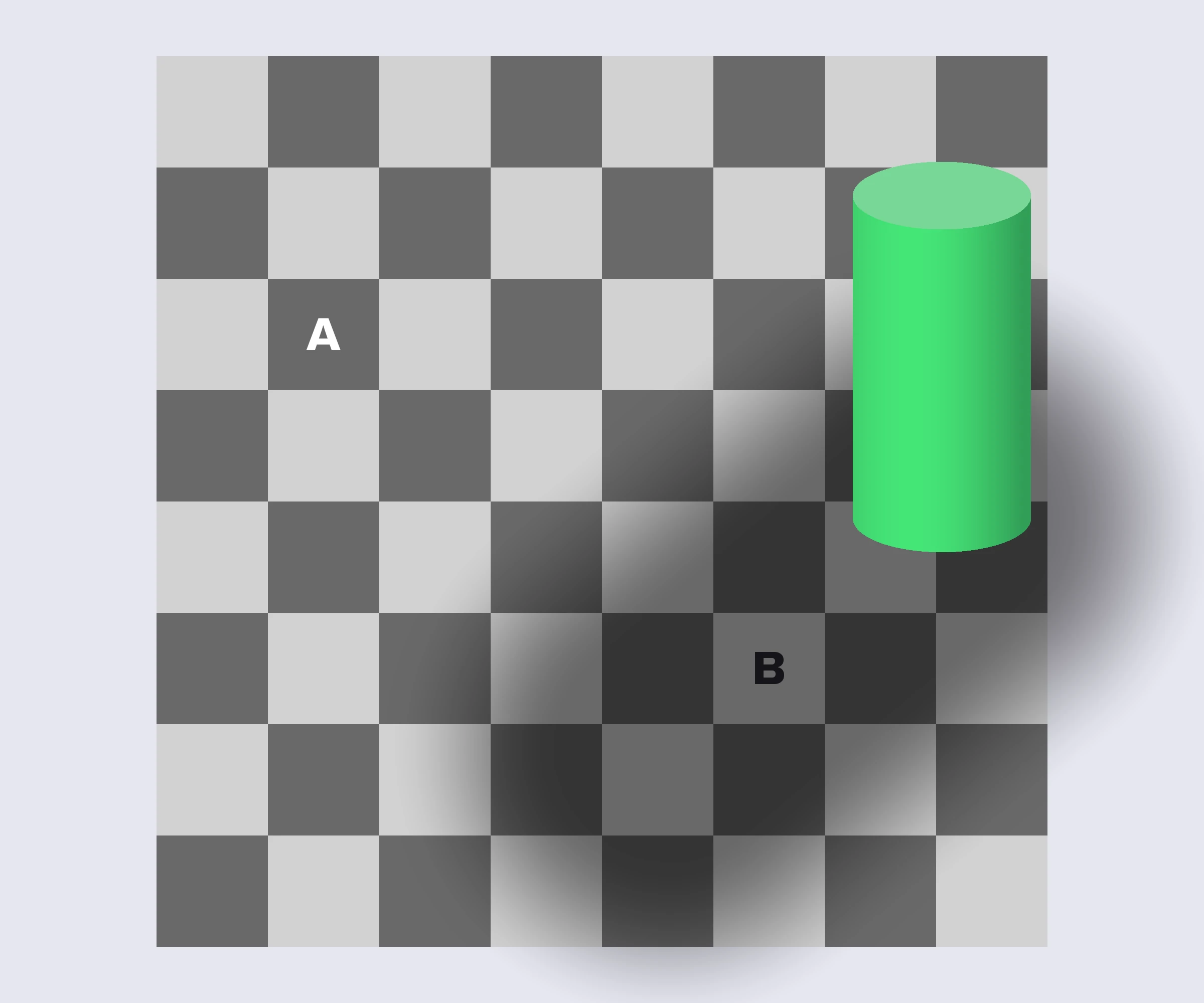
The most famous example is the checker shadow illusion, created by Edward Adelson at the Massachusetts Institute of Technology in 1995. Two squares on a checkerboard, one in the open and one in the shadow of a cylinder, look clearly different. They are exactly the same gray. Your brain knows that shadows make things darker, so it brightens the square in the shadow to show you what the surface "really" is. Adelson explains it on his checker shadow page at MIT.
This is not a mistake in normal life. It is why a white shirt looks white in shade and in sunlight. The same comparing habit is behind simultaneous contrast and many color illusions, which we cover in why colors trick your eyes.
Shortcut 2: read flat pictures as 3D scenes
The image on your retina is flat, so your brain constantly works out depth from clues: lines that come together in the distance, things that overlap, shading and texture. It then adjusts the size of what you see to match how far away it seems to be. That is called size constancy, and it is why a friend walking away from you does not seem to shrink.
Illusions catch this shortcut by adding depth clues to a flat drawing. In the Ponzo illusion, two equal bars sit between lines that come together like railroad tracks. The top bar seems farther away, so your brain enlarges it, and it looks longer. In Shepard's tables, two identical tabletops look completely different in shape because one seems to stretch away from you.
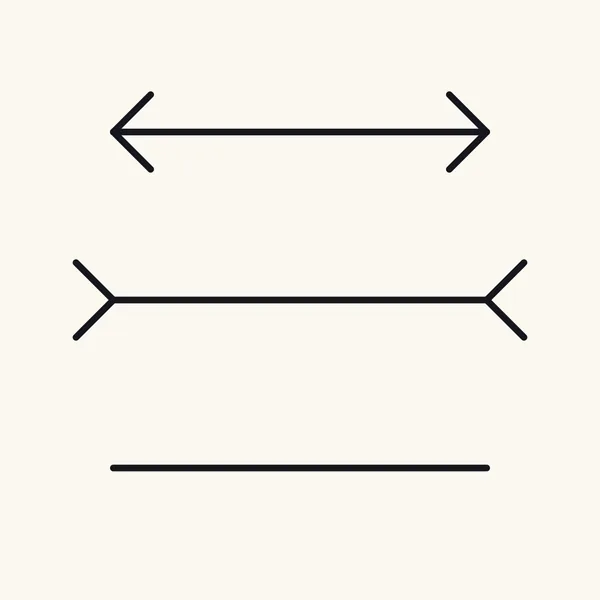
The psychologist Richard Gregory argued that the Müller-Lyer illusion works in a similar way, with the fins acting like the corners of rooms and buildings. That explanation is still debated, and other researchers point to simpler causes, which is a good reminder that the science of illusions is not finished.
Shortcut 3: fill in what is missing
Real objects are often partly hidden. A cat behind a fence is still one cat, not a set of furry strips. So your brain is built to complete shapes, join broken lines and group things that seem to belong together. Early twentieth-century German psychologists, known as the Gestalt school, described many of these grouping rules.
The Kanizsa triangle shows this shortcut at work. Three black circles with wedges cut out and three angled lines are enough to make most people see a bright white triangle on top, complete with edges. There is no triangle and no edge in the picture. Your brain decided a triangle was the simplest explanation and drew it in. The Rubin vase uses a related habit: your brain must decide which part is the object and which is the background, and it cannot see both at once.
Shortcut 4: let tired cells rest
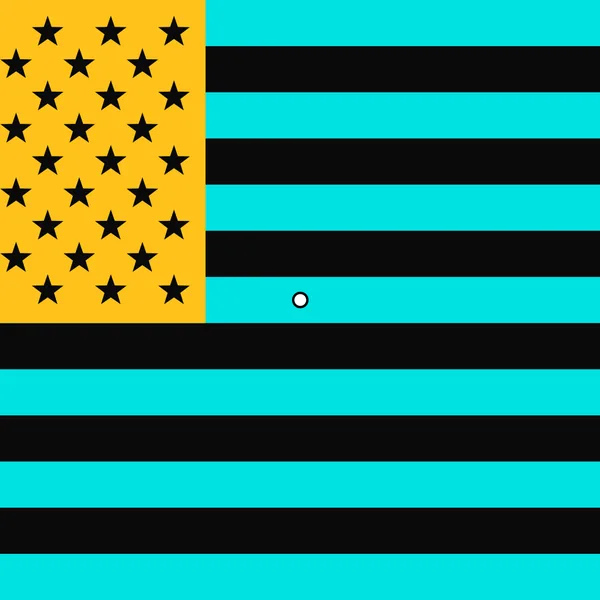
Cells in your visual system adapt. If they keep responding to the same thing, they turn their response down so they stay sensitive to change. Stare at something long enough and the cells that respond to it get tired. When you look away, the rested cells win for a moment, and you see an opposite-colored afterimage or feel still things drifting the opposite way.
Our afterimage flag shows the color version: stare at an oddly colored flag and a normal one appears on white. The motion aftereffect spiral shows the motion version, which people have reported since at least 1834, when Robert Addams described rocks seeming to drift upward after he watched a waterfall.
Shortcut 5: sharpen the edges
Cells in your eye and brain do not only report how much light they get. Many of them compare their spot with the spots around them, which makes edges stand out. This is called lateral inhibition, and it is one reason you can read text easily.
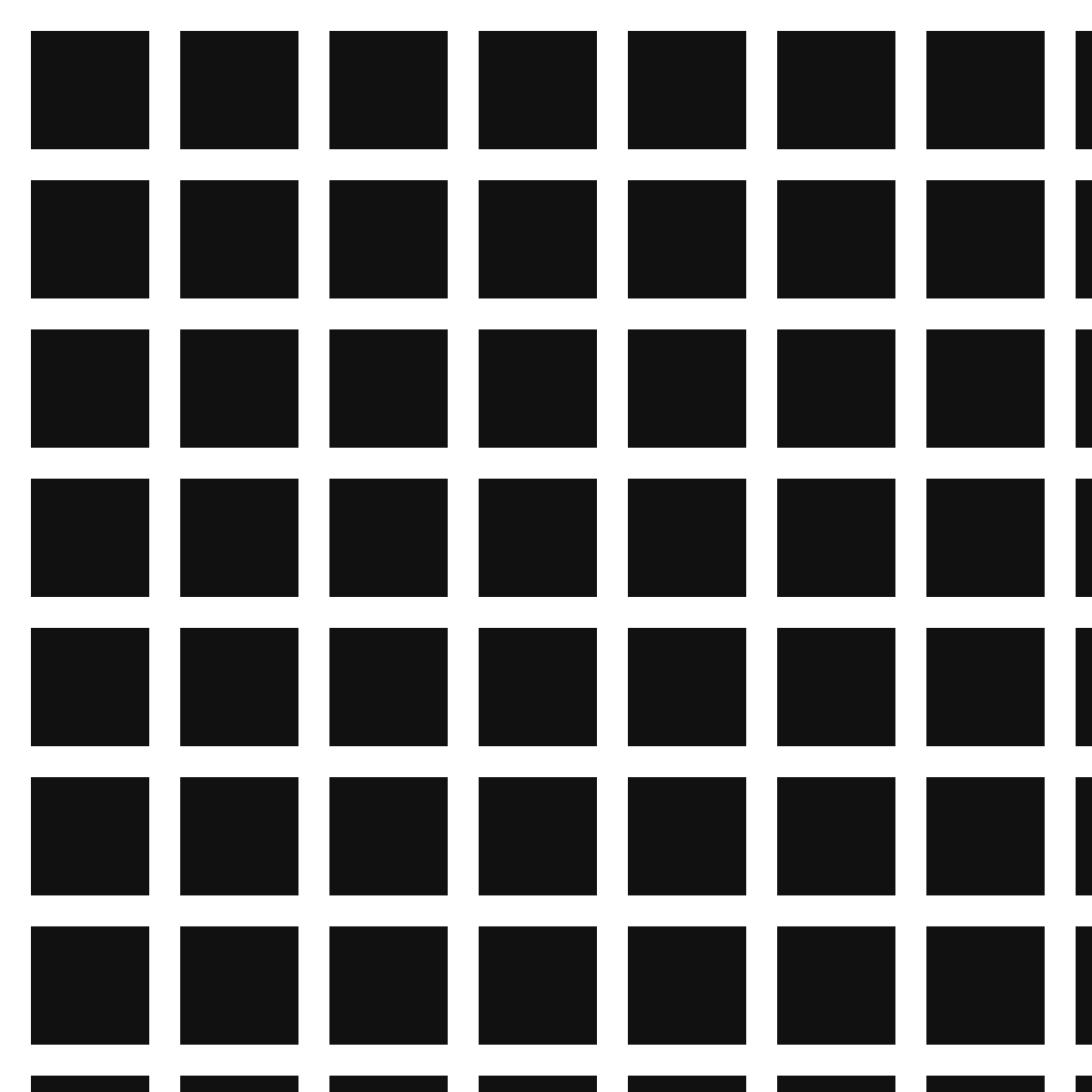
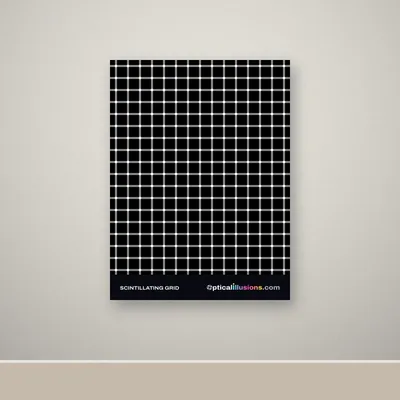
It may also explain the gray ghost dots in the Hermann grid and the bright and dark stripes at the edges of Mach bands. For the Hermann grid, though, the classic explanation has been challenged. In a 2008 study in the journal Perception, János Geier and colleagues showed that bending the white lines into gentle waves makes the gray dots vanish, which the classic theory does not predict (study summary on PubMed). Scientists now think processing higher in the brain is involved too.
Shortcut 6: predict the moment
Signals take time to travel from your eyes to the parts of the brain that make sense of them, roughly a tenth of a second. The American Institute of Physics notes that this lag is one reason the brain takes shortcuts. Some researchers think the brain partly makes up for it by predicting where things will be.
Timing also matters inside the visual system. Strong, high-contrast edges are signaled a little faster than weak ones. In the peripheral drift illusion, a still pattern arranged in a careful order of brightness sends fast and slow signals that motion detectors mistake for real movement. Our guide to why still pictures seem to move explains that one in detail.
When the picture has two answers
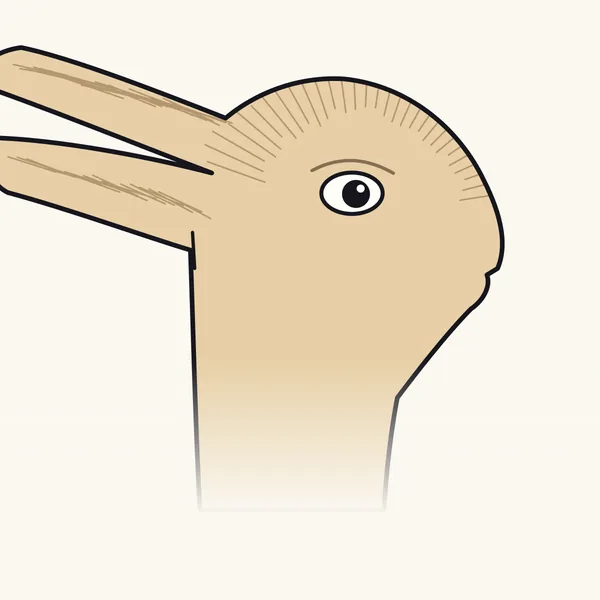
Some pictures are not tricking a shortcut so much as offering two equally good answers. The Necker cube can be a cube seen from above or from below. The rabbit-duck can be either animal. Your brain commits to one interpretation at a time and then, after a few seconds, often flips. You can learn to flip some of these on purpose, but you cannot see both answers at the same moment.
Why knowing the trick does not help
Here is one of the strangest facts about illusions: knowing the answer usually changes nothing. You can measure the Müller-Lyer lines with a ruler, confirm they are equal and look again, and one still looks longer. That tells us that much of seeing happens in fast, automatic processing that your conscious knowledge cannot reach in time. For most of history, that speed has kept us alive. Being able to judge a falling branch or a moving car instantly is worth the occasional fooled square on a checkerboard.
So illusions are not signs that your vision is bad. They are signs that it is clever. Each one exposes a smart rule your brain uses all day, every day, by showing you the rare picture where the rule fails. To see how these shortcuts sort into families, read our guide to the types of optical illusions, or test yourself with the optical illusion test.
Try it yourself
Pick one illusion from each shortcut above and try to explain it in your own words before you read its page. If you are looking for a school project, our list of optical illusion science fair projects turns several of these into experiments.
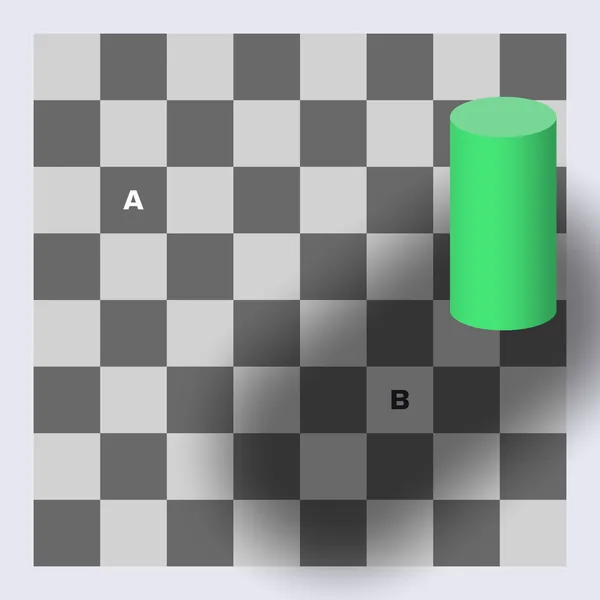 InteractiveBrightness illusionsCheckerboard Shadow IllusionA dark square in light and a light square in shadow are the same gray.
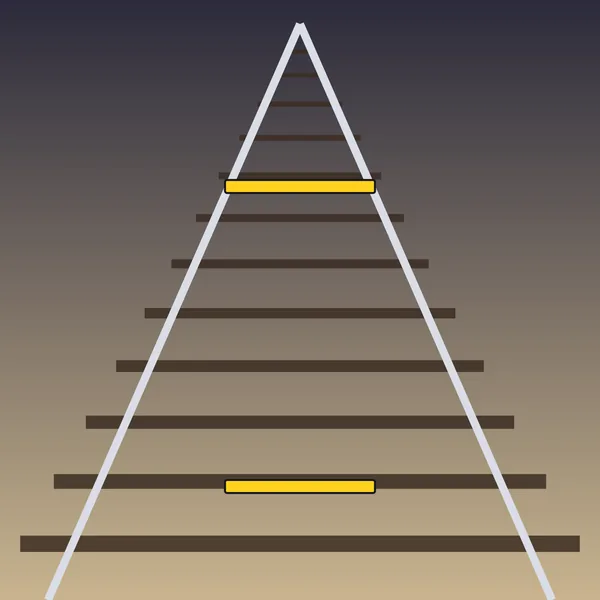 Geometric illusionsPonzo IllusionTwo equal bars on converging rails look like different lengths.
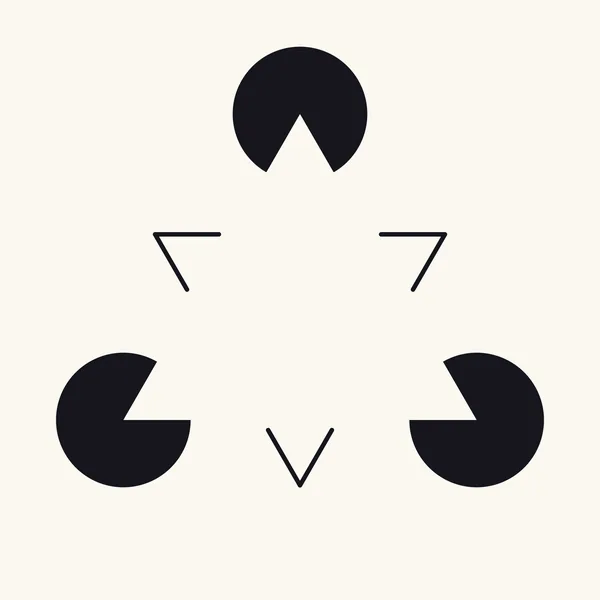 Geometric illusionsKanizsa TriangleA bright white triangle appears from nothing but three cut-out discs.
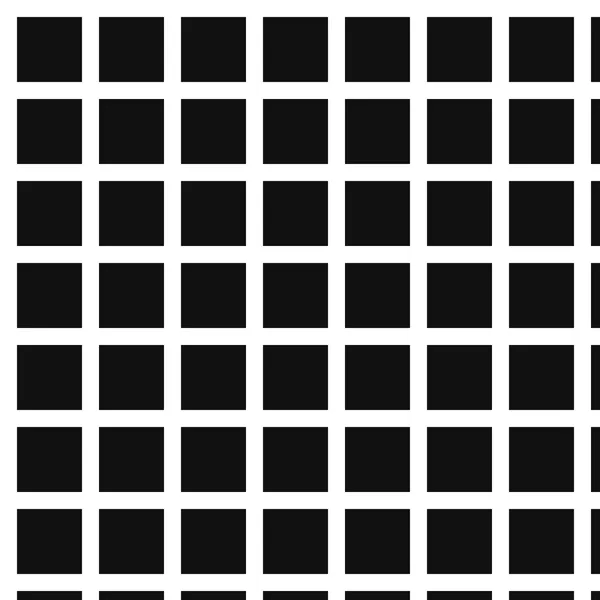 Brightness illusionsHermann GridGray smudges flicker at the crossings of a black-and-white grid.
Questions and answers
Why do optical illusions work?
Your brain does not record the world like a camera. It makes fast best guesses from incomplete information, using shortcuts such as comparing things with their surroundings and reading flat pictures as 3D scenes. Illusions are pictures where those shortcuts give the wrong answer.
Do optical illusions trick your eyes or your brain?
Mostly the brain. A few effects begin in the eye itself, such as afterimages from tired cone cells, but most illusions come from how the brain interprets the signals the eyes send.
Why can I still see an illusion after I know the trick?
Much of seeing happens automatically and very quickly, before your conscious knowledge can step in. That is why equal lines still look unequal even after you have measured them.
Does everyone see optical illusions the same way?
Not exactly. Most people are fooled by the classic illusions, but how strongly varies from person to person, and a few illusions, such as the famous dress photo, split people into groups.
Enjoyed this? Get a new illusion every week
One original illusion in your inbox each week, with the science explained in a minute.
Written by the Opticalillusions.com team · Published . Illusion artwork © The Wizard Of Sales, LLC. Spotted an error? Tell us.
More from Learn
 Learn · Guide15 Famous Optical Illusions and the Stories Behind ThemFrom the Necker cube of 1832 to the dress of 2015: the famous illusions everyone should know, who made them and why they work.
 Learn · GuideThe Penrose Triangle and Other Impossible Objects, ExplainedWhy the impossible triangle, cube and fork look solid but could never be built, and how artists fake them in real life.
 Learn · GuideWhy Ambiguous Pictures Flip: The Rabbit-Duck, Rubin Vase and MoreA rabbit or a duck? A vase or two faces? Why two-answer pictures flip, why you never see both, and how to switch on purpose.
 Learn · GuideAfterimage Illusions: Why You See Colors That Aren't ThereStare, look away, and a ghost picture appears in opposite colors. How afterimages work and why they flip red to cyan and blue to yellow.
 Learn · GuideBlind Spot Test: Find the Hole in Your Vision in One MinuteMake a dot vanish and a broken line repair itself. A one-minute test for the blind spot every eye has, and why you never notice it.
 Learn · Guide9 Easy Optical Illusions You Can Do at HomeA floating finger, a hole in your hand, a rubber pencil and more: nine illusions you can do with things you already have.Learn · GuideHow to Draw Optical Illusions: 4 Easy Step-by-Step IdeasFour easy illusions anyone can draw with a pencil, ruler and marker, with step-by-step pictures and the science behind each trick.
 Learn · GuideWhat Is Op Art? Optical Illusion Art ExplainedPaintings that ripple, bulge and buzz: how 1960s op artists used lines, grids and color to trick the eye, and how to make your own.
 Learn · GuideAre Optical Illusions Bad for Your Eyes? Facts and MythsDo illusions hurt your eyes? The facts on eye strain and dizziness, who should take care with flashing patterns, and the viral myths.
 Learn · GuideHow Magic Eye Pictures Work (and How to See Them)The science of hidden 3D pictures, from a 1959 lab experiment to the 1990s craze, plus a step-by-step way to see the shape.
 Learn · GuideWhy Do Still Pictures Seem to Move? Motion Illusions ExplainedDrifting snakes, wobbling checks and spinning rings: how your eye movements and motion cells turn flat pictures into motion.Learn · GuideOptical Illusion Science Fair Projects: 8 Ideas That WorkEight testable project ideas, from measuring the Müller-Lyer illusion to timing afterimages, with tips on fair tests and fair rules.
 Learn · GuideTypes of Optical Illusions, Explained (With Examples)Literal, physiological and cognitive illusions, plus motion, color, geometric, ambiguous, impossible and afterimage illusions, with an example of each.
 Learn · GuideWhy Colors Trick Your Eyes: The Science of Color IllusionsColor constancy, simultaneous contrast, the Munker illusion and afterimages: how your brain builds color, and why it sometimes gets it wrong.
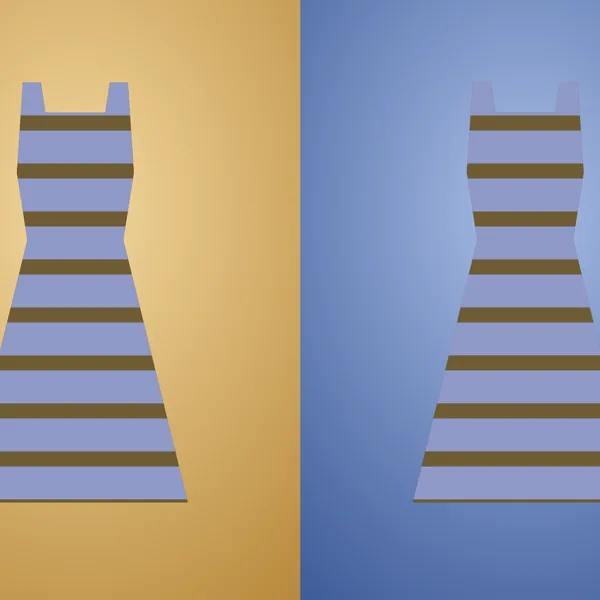 Learn · GuideThe Dress: Why Everyone Saw It DifferentlyBlue and black or white and gold? The 2015 photo, the lighting assumptions behind it and what scientists found when they studied it.