
Why Ambiguous Pictures Flip: The Rabbit-Duck, Rubin Vase and More
Some pictures have two right answers. The rabbit-duck is both animals. The Rubin vase is a vase and two faces. Your brain can show you either one, but never both at the same moment. Here is why ambiguous pictures flip, and how you can learn to flip them yourself.
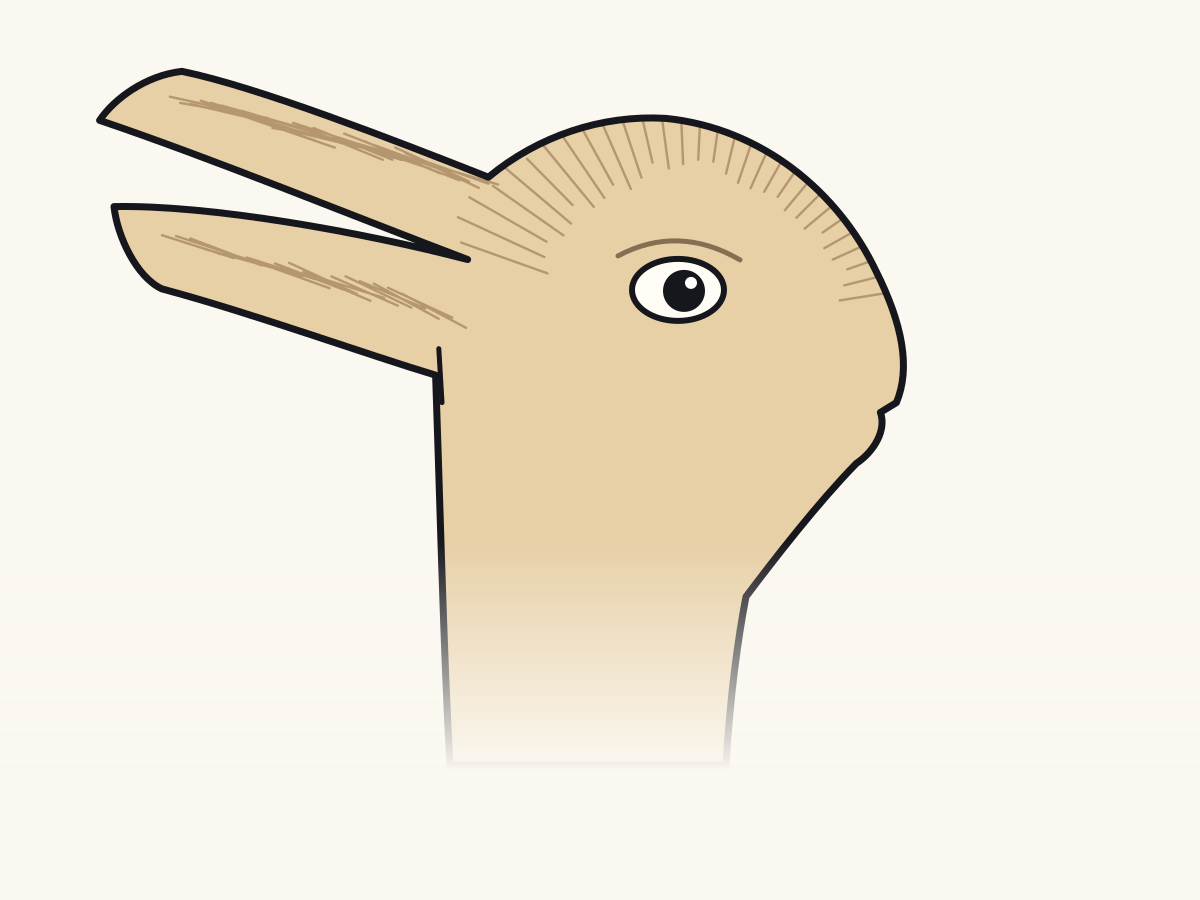
What is an ambiguous picture?
An ambiguous picture is an image that fits two different meanings equally well. Scientists also call these reversible or bistable figures, because they have two stable ways of being seen and they flip between them.
Most optical illusions trick you into seeing something that is wrong, like equal lines that look unequal. Ambiguous pictures are different. Nothing you see is wrong. The rabbit-duck really is a good rabbit and a good duck. The puzzle is what your brain does when it has two right answers.
Why you can only see one answer at a time
Here is the strange part. Look at the rabbit-duck and you see a duck, or you see a rabbit. You never see a mixed-up rabbit-duck creature, and you cannot hold both animals in your mind at the same instant.
That tells us something important about how seeing works. Your brain does not just pass along the lines on the page. It decides what those lines are, and it commits to one complete answer. The long shapes are either a beak or ears. The notch is either the back of a duck's head or a rabbit's mouth. Every part of the drawing gets assigned to one story, all at once.
Think of it like a light switch rather than a dimmer. The brain picks one explanation and runs with it, because in the real world one explanation is almost always correct. An animal in a field is a rabbit or a duck, not both.
Why the picture flips
If the brain commits to one answer, why does it switch? Scientists do not have a complete answer, but two ideas explain much of it.
The first is tiredness, or adaptation. The groups of nerve cells that support one interpretation slowly get less responsive the longer they are active. Meanwhile, the cells supporting the other interpretation are resting. After a few seconds the balance tips, and the picture flips. Then the same thing happens in reverse.
The second is attention and where you look. Your eyes are always making tiny movements, and different parts of the drawing favor different answers. Looking at the left side of the rabbit-duck, where the beak or ears are, tends to bring one animal forward. Looking at the right side can bring the other.
Researchers call this whole process perceptual bistability, and they use ambiguous pictures to study how the brain settles competition between ideas.
Famous ambiguous pictures
The rabbit-duck
The earliest known version appeared in a German humor magazine in October 1892. The American psychologist Joseph Jastrow used it in 1899 to argue that seeing involves the mind, not just the eyes. Your expectations matter too. In a 1993 study, people shown the drawing at Easter were more likely to name a rabbit, while people shown it in October more often saw a bird (study record on PubMed).
The Rubin vase
The Danish psychologist Edgar Rubin made this picture famous in 1915. Our Rubin vase shows a golden vase on a dark background, or two dark faces nose to nose on a golden background. This one is about figure and ground: your brain must decide which part is the object and which part is the background behind it. The curvy edge can belong to the vase or to the faces, but not both, so you see one or the other.

The Necker cube
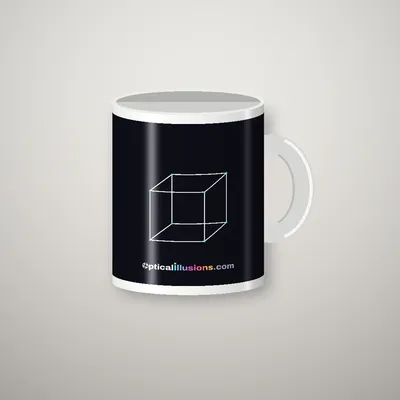
The Necker cube is a wire box drawn with twelve lines. It was described by the Swiss scientist Louis Albert Necker in 1832. One moment the front face sits low and to the left. The next, it jumps up and to the right. Once you have seen both, it can be hard to make it stop flipping.
Schröder stairs
The Schröder stairs can be a staircase you could walk up, or the underside of a staircase seen from below. Turn the page upside down and the other version usually becomes easier to see.
The spinning dancer
A spinning silhouette has no clues about which side is closer to you, so it can turn either way. Our spinning dot globe works the same way as the famous dancer animation: some people see it turn left, some right, and many see it reverse while they watch.
How to flip an ambiguous picture on purpose
You can learn to control many ambiguous pictures. Try these tricks:
- Move your eyes. For the rabbit-duck, look at the eye and then at the long shapes. For the Necker cube, stare at one corner and imagine it poking out toward you.
- Tell yourself what to see. Say "rabbit" in your head and look for the ears. Expecting one answer makes it more likely to win.
- Look for the key part. In the Rubin vase, look for a nose and lips along the edge to find the faces, or for the base and lip of the vase.
- Blink or look away. A short break often lets the other answer take over when you look back.
- Turn it. Rotating some pictures, like the Schröder stairs, can bring out the other version.
With practice, many people can flip the Necker cube almost whenever they want. What nobody can do is see both versions at the same time.
Do ambiguous pictures reveal your personality?
You may have seen posts that say "What you see first reveals your personality." These are fun, but there is no good scientific evidence that a first impression of an ambiguous picture says anything about your character. What you see first depends mostly on simple things: where your eyes landed, what you were thinking about, and small details of the drawing. Some versions of the rabbit-duck are drawn to look more like a duck, and some more like a rabbit.
For a light-hearted version, try our What do you see first? picture test, which compares your first impressions with the real science.
Why ambiguous pictures matter
Ambiguous pictures prove that seeing is not like a camera. The image on your retina stays exactly the same while your experience of it changes completely. Something in your brain is making the choice. That makes these pictures one of the simplest windows into how the mind builds the world you see.
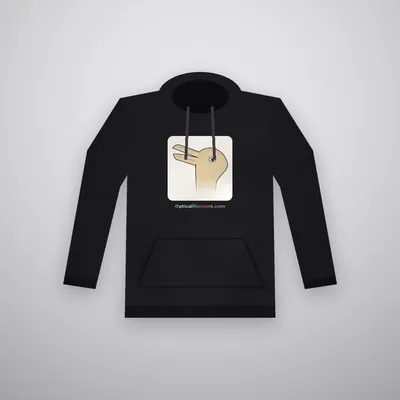
Explore more two-answer images in our collection of ambiguous figures, read about the other families in types of optical illusions, or take a look at their cousins, the impossible objects. Teachers can find printable illusion packs on our For Teachers page, and the rabbit-duck is also available on tees and mugs in our shop.
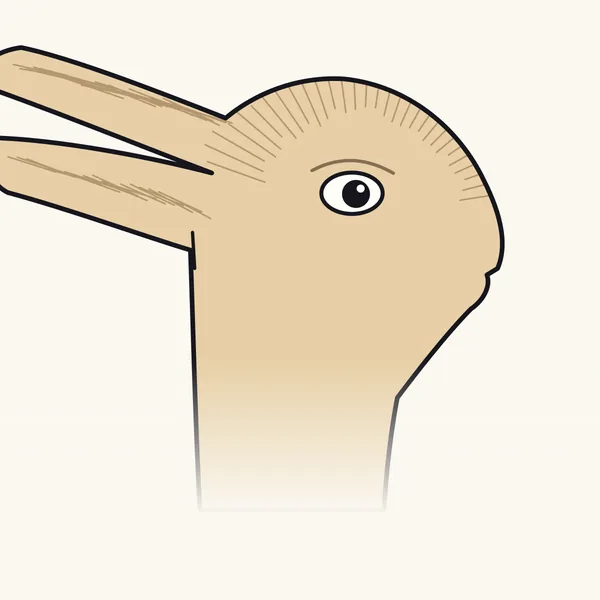 InteractiveImpossible & ambiguous figuresRabbit-Duck IllusionOne drawing, two animals: a duck facing left or a rabbit facing right.
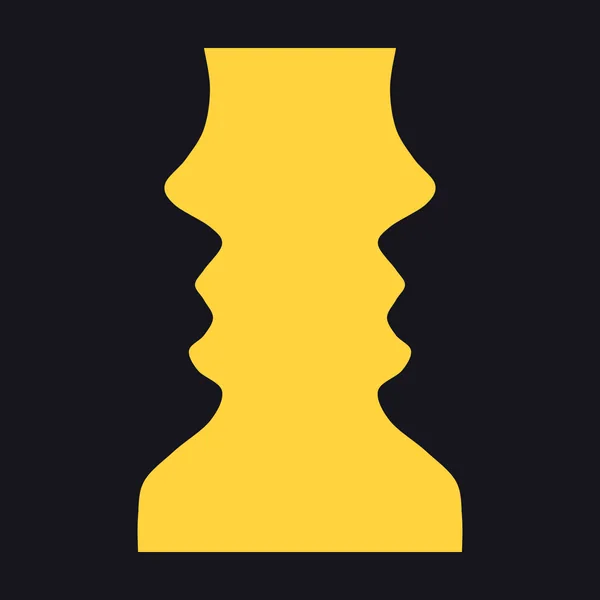 Impossible & ambiguous figuresRubin VaseA golden vase, or two dark profiles facing each other.
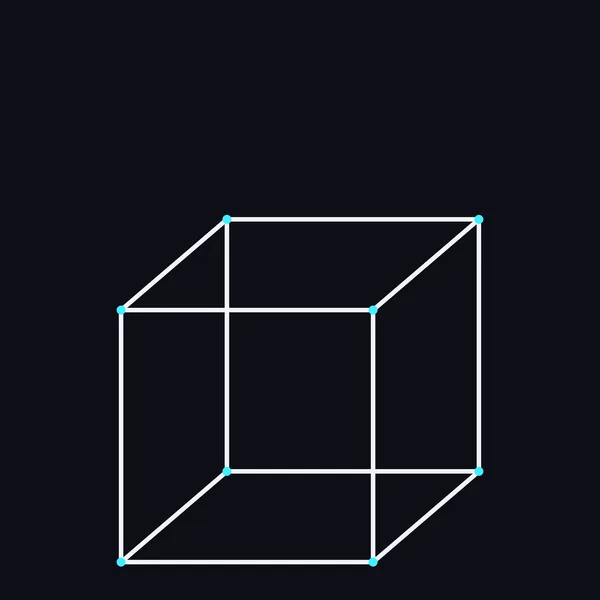 Impossible & ambiguous figuresNecker CubeA wireframe cube that flips between two orientations.
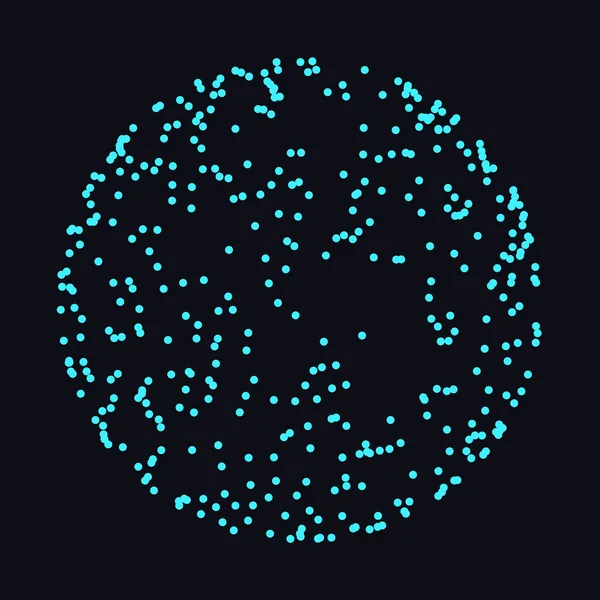 InteractiveImpossible & ambiguous figuresSpinning Dancer IllusionA spinning silhouette that turns clockwise for some people and the other way for others.
Questions and answers
What is an ambiguous image?
An ambiguous image is a picture that fits two different interpretations equally well, such as the rabbit-duck or the Rubin vase. Your brain shows you one interpretation at a time and flips between them.
Why can't I see both pictures at once?
Your brain commits to one complete explanation of the image. Each part of the drawing gets assigned to one interpretation, so you see either the rabbit or the duck, never both at the same moment.
Why does an ambiguous picture flip by itself?
The brain cells supporting the interpretation you are seeing slowly tire, while the cells for the other one rest. Where you look and what you expect also push the picture to flip.
Does what you see first say something about your personality?
There is no good scientific evidence for that. What you see first mostly depends on where your eyes land, what you expect and how the drawing is made.
Enjoyed this? Get a new illusion every week
One original illusion in your inbox each week, with the science explained in a minute.
Written by the Opticalillusions.com team · Published . Illusion artwork © The Wizard Of Sales, LLC. Spotted an error? Tell us.
More from Learn
 Learn · Guide15 Famous Optical Illusions and the Stories Behind ThemFrom the Necker cube of 1832 to the dress of 2015: the famous illusions everyone should know, who made them and why they work.
 Learn · GuideThe Penrose Triangle and Other Impossible Objects, ExplainedWhy the impossible triangle, cube and fork look solid but could never be built, and how artists fake them in real life.
 Learn · GuideAfterimage Illusions: Why You See Colors That Aren't ThereStare, look away, and a ghost picture appears in opposite colors. How afterimages work and why they flip red to cyan and blue to yellow.
 Learn · GuideBlind Spot Test: Find the Hole in Your Vision in One MinuteMake a dot vanish and a broken line repair itself. A one-minute test for the blind spot every eye has, and why you never notice it.
 Learn · Guide9 Easy Optical Illusions You Can Do at HomeA floating finger, a hole in your hand, a rubber pencil and more: nine illusions you can do with things you already have.
 Learn · GuideHow to Draw Optical Illusions: 4 Easy Step-by-Step IdeasFour easy illusions anyone can draw with a pencil, ruler and marker, with step-by-step pictures and the science behind each trick.
 Learn · GuideWhat Is Op Art? Optical Illusion Art ExplainedPaintings that ripple, bulge and buzz: how 1960s op artists used lines, grids and color to trick the eye, and how to make your own.
 Learn · GuideAre Optical Illusions Bad for Your Eyes? Facts and MythsDo illusions hurt your eyes? The facts on eye strain and dizziness, who should take care with flashing patterns, and the viral myths.
 Learn · GuideWhy Do Optical Illusions Work? How Your Brain GuessesSeeing is a best guess. The six shortcuts your brain uses, and the illusions that catch each one, explained in plain words.
 Learn · GuideHow Magic Eye Pictures Work (and How to See Them)The science of hidden 3D pictures, from a 1959 lab experiment to the 1990s craze, plus a step-by-step way to see the shape.
 Learn · GuideWhy Do Still Pictures Seem to Move? Motion Illusions ExplainedDrifting snakes, wobbling checks and spinning rings: how your eye movements and motion cells turn flat pictures into motion.Learn · GuideOptical Illusion Science Fair Projects: 8 Ideas That WorkEight testable project ideas, from measuring the Müller-Lyer illusion to timing afterimages, with tips on fair tests and fair rules.
 Learn · GuideTypes of Optical Illusions, Explained (With Examples)Literal, physiological and cognitive illusions, plus motion, color, geometric, ambiguous, impossible and afterimage illusions, with an example of each.
 Learn · GuideWhy Colors Trick Your Eyes: The Science of Color IllusionsColor constancy, simultaneous contrast, the Munker illusion and afterimages: how your brain builds color, and why it sometimes gets it wrong.
 Learn · GuideThe Dress: Why Everyone Saw It DifferentlyBlue and black or white and gold? The 2015 photo, the lighting assumptions behind it and what scientists found when they studied it.